When someone you love has Essential Tremor, you want to help. That instinct is the right one. But help, in this context, requires a kind of careful attention that is different from most caregiving situations. Essential Tremor affects visible, social, dignity-laden tasks — eating in public, signing your name, carrying a drink across a room — and the support that works is often quieter and more thoughtful than what feels natural in the moment.
This guide is written for the people around someone with Essential Tremor. Spouses, adult children, friends, coworkers. It covers what the condition actually feels like from the inside, what practical support looks like across daily tasks, which instinctive responses tend to backfire, and how to navigate the emotionally loaded conversations that caregiving for ET involves. It also covers where to find community and resources for yourself as a supporter — because caring for someone with a chronic condition takes something from you, too.

What Essential Tremor Actually Feels Like from the Inside
Essential Tremor is most visible in its physical expression — a shaking hand, a spilled drink, a signature that comes out as a scribble. But understanding what the condition is like to live inside changes how you show up for someone experiencing it.
Essential Tremor is an action tremor, meaning it activates during intentional movement. When someone with ET is sitting still watching television, the tremor is often barely noticeable. When they reach for a cup of coffee, try to sign a credit card receipt, or pour water from a pitcher, the tremor engages. This creates a particular kind of experience: moments of relative normalcy interrupted by conspicuous functional difficulty at the most socially visible moments. Eating at a restaurant. Paying at a checkout counter. Meeting someone new and extending a hand.
Research from Yale University on the emotional experience of ET caregiving found that embarrassment is one of the most significant emotional impacts of the condition. Not pain, not physical limitation alone — embarrassment. The awareness of being watched, of shaking in public, of drawing attention through an involuntary movement that, to others, looks like nervousness or anxiety. Many people with essential tremor progressively reduce their social activities, stop eating at restaurants, decline invitations, and shrink their world to avoid the situations where tremor is most visible and most humiliating.
This has a compounding effect. The social withdrawal itself reduces quality of life, increases isolation, and often worsens the emotional state that amplifies tremor. Anxiety and stress are direct tremor triggers, and the anxiety of anticipating embarrassment produces exactly the physiological arousal that makes tremor worse.
One more dimension worth understanding: the gap between how someone with ET looks and how they are actually functioning. Because ET decreases at rest, there are periods when the person appears entirely fine to observers. Family members who have not seen a bad tremor episode may underestimate the condition's functional impact. "They seemed totally normal at the family dinner," and "they had to ask me to pour their coffee for them the next morning" can both be true about the same person on different days, or even at different times on the same day. The variability itself is disorienting for the person experiencing it and easily misread by those around them.
What Helps: Practical Ways to Support Someone with Essential Tremor
The most useful support for Essential Tremor is domain-specific. What helps at mealtimes is different from what helps in social settings, which is different from what helps with paperwork and writing tasks. Here is practical guidance organized by context.
At mealtimes and in the kitchen, the most impactful changes are structural rather than interventional. Adaptive utensils, weighted silverware, scoop plates, and non-slip mats on the table can be introduced as standard household items rather than as special accommodations. When these things are simply part of the table setting, using them does not require the person with ET to acknowledge difficulty or accept help. Travel mugs with lids and two-handled cups can be the default for hot drinks without anyone needing to comment on why.
Serve beverages to a safe level rather than filling cups to the brim. Choose restaurants with booths or bench seating that provide more table stability than free-standing chairs. Avoid buffet-style restaurants where carrying a loaded plate across a room is unavoidable. When dining out, offer to handle the card reader or receipt signing naturally as part of the payment process, without drawing attention.
When cooking together, take on the tasks that require fine motor precision — chopping, peeling, pouring from heavy containers — while leaving the person with ET tasks they can perform well. This preserves their participation in the kitchen without forcing them to handle the hardest tasks.
In social situations and public settings, the most valuable thing you can do is create a sense of normalcy. Do not call attention to a tremor in front of people who are not aware of it. Do not whisper comments about tremor in public settings. If the person with ET is struggling with a task at the table, create a natural conversational diversion rather than calling attention to the difficulty. Handle things quietly and move on.
When someone new is introduced who does not know about the ET, follow the person's lead on disclosure. It is their choice to explain or not, on their own terms and timeline.
For writing and paperwork tasks, provide practical alternatives. Offer to fill in forms and leave only the signature line. Suggest digital alternatives for signatures where they exist. Keep a pre-printed address label available for situations that require repeatedly writing an address. Digital payment options that eliminate signatures entirely are worth using consistently.
For more detailed guidance on specific daily activities, the pages on eating, writing, and drinking with essential tremor cover adaptive strategies in depth.
Mealtime and Kitchen Support
Setting the table with adaptive utensils as standard practice removes the need for the person with ET to request them or acknowledge needing them. Bowls are generally easier to eat from than flat plates because they allow scooping against a raised edge. A scoop plate, which has a deliberately raised inner rim, can serve this purpose without looking significantly different from standard dinnerware.
If something spills, clean it up without comment. Spills are a mechanical consequence of the condition, not a reflection of carelessness or failure. Treating them as unremarkable is one of the most quietly powerful forms of support you can offer.
Social Situations and Public Settings
When dining out, a table with more clearance is generally easier than a tight booth. More room to maneuver utensils, more surface area to stabilize against, and more space for a bag or adaptive items make the meal less physically demanding.
If the person with ET is handling payment and appears to be struggling with a card reader or signature pad, offer casually — "here, let me get that" — and move the conversation forward. The goal is to make the moment unremarkable, not to rescue them from it.
What Doesn't Help: Common Mistakes Supporters Make
This section covers the territory that essential tremor patients most often wish people in their lives would understand. The instincts that seem helpful in the moment often undermine the thing people with ET need most: to feel capable and in control of their own lives.
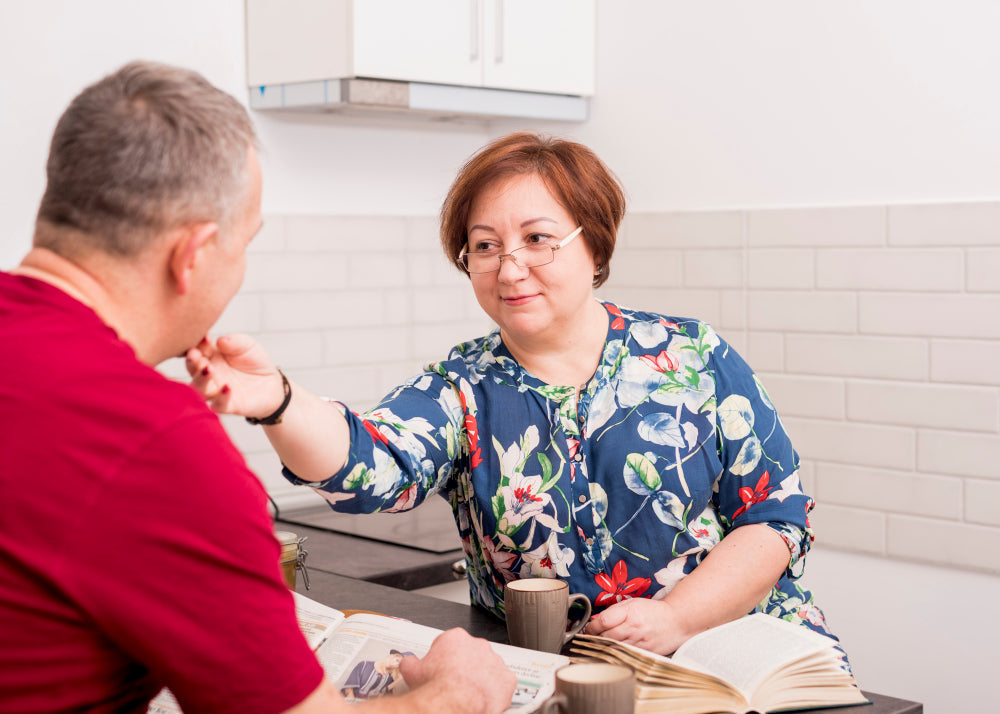
Do not grab their hand to steady it. This is perhaps the most common instinctive response when watching someone you love struggle with a tremor. It feels like helping. For the person with ET, it removes their agency over their own body. It signals that you do not trust them to manage the situation. And it can be physically startling. The impulse comes from a good place, but the effect is the opposite of supportive.
Do not complete tasks for them without asking. Watching someone struggle with a button, a utensil, or a payment terminal when you could fix it in three seconds is genuinely uncomfortable. That discomfort belongs to you, not them. Jumping in without being invited communicates that you do not believe they can manage. The simple alternative — "Do you want help with that, or do you have it?" — gives them the choice. Sometimes they want help. Sometimes they need to do it themselves. Asking for respect.
Do not stare at the tremor. Most people are not aware that they are doing this. If you notice the tremor, look away. Focus on the conversation, the environment, anything other than the shaking hand. Others follow the lead of the people closest to the person with ET. If you treat it as unremarkable, others are more likely to do the same.
Do not say "just relax." Stress activates the sympathetic nervous system and directly amplifies tremor. Telling someone with ET to relax increases their anxiety about the tremor, which increases the tremor itself. It is not useful advice, and it implies that the shaking is within voluntary control. It is not.
Do not treat them as fragile or incapable. Essential tremor affects motor function. It does not affect intelligence, judgment, professional competence, or the full range of human capability. Many people with ET are highly functional in their careers, creative endeavors, and personal lives. The tremor is one dimension of a complete person, not a summary of who they are.
Do not minimize their experience. "You're not that bad" or "you can barely see it" are meant as reassurance but land as invalidation. Essential Tremor severity fluctuates across the day and across days. The fact that the tremor was mild at the moment you observed it does not mean it is mild at the moments that matter most to the person living with it. Their experience of the condition is the authoritative one.
The single most useful reframe for supporters is this: the goal is not to eliminate the difficulty. It is to make the difficulty unremarkable so the person with ET does not have to manage their reaction alongside their own.
The Emotional Side of Essential Tremor Caregiving
The Yale study on caregiving in Essential Tremor, one of the few academic examinations of this relationship, found that ET caregiving centers on three themes: providing companionship, promoting independence, and reducing embarrassment. These themes are meaningfully different from the caregiving frameworks built around physically progressive conditions. Essential Tremor caregiving, for most of the condition's course, is not primarily about physical tasks. It is about emotional presence, social navigation, and preserving the person's sense of self.
This can be disorienting for people who want to help concretely. The urge to fix things, to find a solution, to solve the problem of the tremor, runs directly into the reality that the most valuable support is often less active. Sitting with someone at a restaurant while they eat slowly. Being present without commentary. Not making them explain their condition to the waiter.
Caregivers often feel helpless in this situation. Watching someone struggle with something that was once automatic, knowing there is no action you can take that makes the tremor go away, is genuinely hard. That helplessness is valid. It does not need to be resolved by finding something to do. Sometimes it just needs to be acknowledged.
The urge to help can also conflict with the need to preserve independence. These two impulses pull in opposite directions, and finding the balance between them is the ongoing challenge of Essential Tremor caregiving. Helping too much creates dependence and communicates diminished capability. Helping too little leaves someone struggling unnecessarily. The calibration is individual and changes as the condition progresses. The best way to find it is to ask, directly and sincerely, what kind of support the person with ET actually wants.
Caregiver fatigue is real in Essential Tremor, even though the condition does not follow the acute-decline arc seen in other neurological diseases. Chronic social vigilance, the sustained attention required to navigate public situations smoothly, and the emotional labor of managing embarrassment on someone else's behalf accumulate. If you are a long-term caregiver for someone with ET and you feel worn down by it, that is not an overreaction. It is a recognizable consequence of sustained caregiving.
Take care of your own support system. Seek out other people who understand what ET caregiving involves. The resources section at the end of this guide includes communities where caregivers can connect with others in similar situations. Taking care of yourself is not a diversion from caring for the person with ET. It is what makes sustainable support possible.
How to Introduce Adaptive Tools Without Making Them Feel Diminished
Suggesting an adaptive device to someone with Essential Tremor is one of the most emotionally loaded moments in the caregiving relationship. For many people, accepting a tremor stabilization device or adaptive utensil feels like formally acknowledging a limitation, conceding something to the condition, crossing a threshold they had been managing to stay behind. Even when a tool would genuinely help, the emotional weight of accepting it can be significant.
The way a tool is introduced matters as much as the tool itself.
Frame the device as a performance enabler, not a disability accommodation. The distinction is real and important. A weighted utensil, an adaptive cup, or a tremor stabilization glove does not create new capability — it removes a barrier to the capability the person already has. They want to eat. They want to drink coffee without spilling. They want to write legibly. The tool helps them do what they were already trying to do. That framing is very different from "this helps with your condition."
Where possible, let the recommendation come from an occupational therapist or neurologist rather than from you. Professional endorsement carries a different weight than family suggestion. A family member suggesting a device can feel like a comment on what they have been observing. A neurologist's recommendation of the same device is part of treatment planning. If the person with ET has not yet seen an OT for adaptive device assessment, that referral is worth requesting at their next neurology appointment.
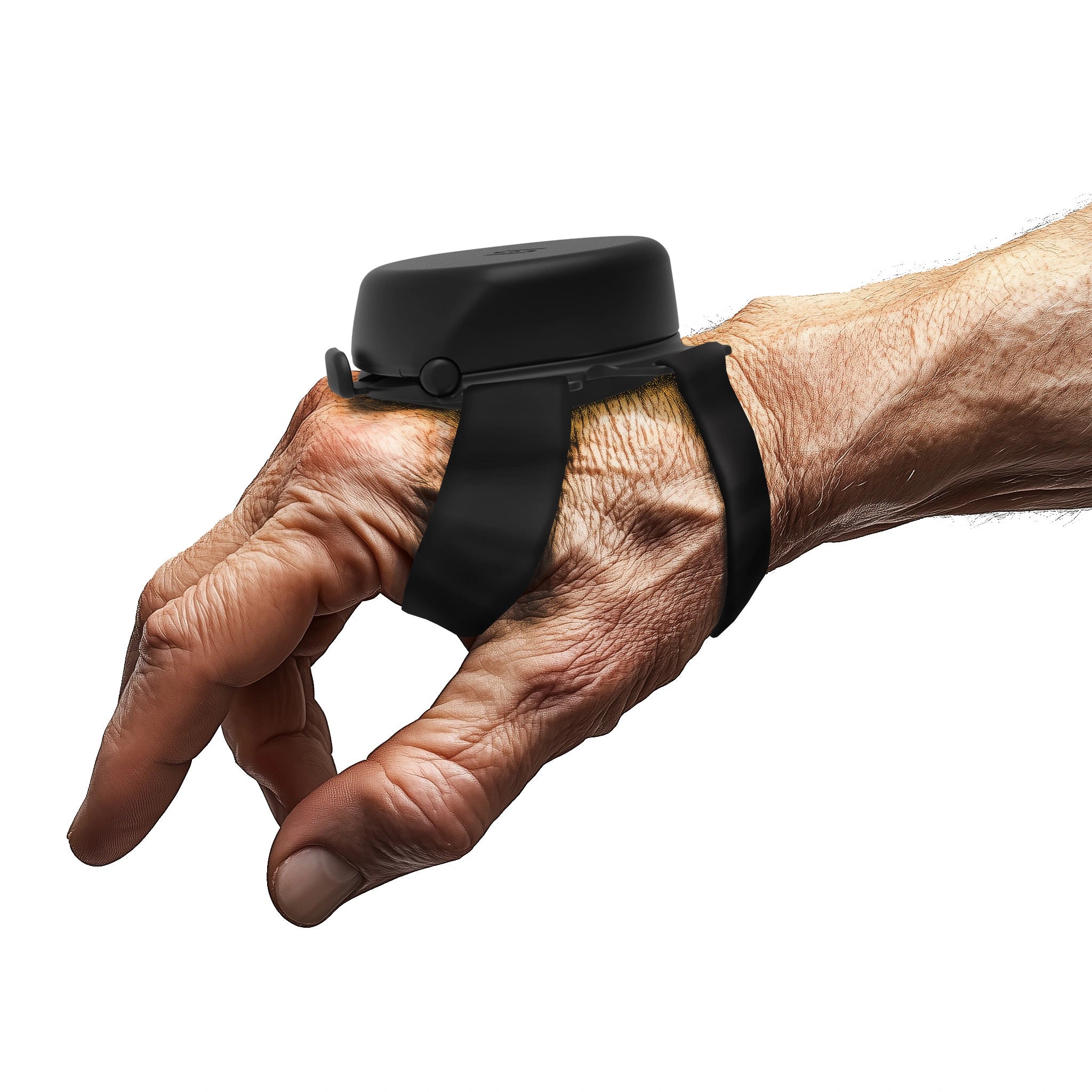
If you are considering gifting a tool like the Steadi-3, present it as the result of your own investment in understanding what they are experiencing. "I read about how tremor actually works and came across this — I thought it might be worth trying" is received differently than "I got you something that might help with the shaking." The first communicates that you wanted to understand their experience. The second centers the tremor as the problem.
The Steadi-3's appearance helps here. It is designed to look like a functional glove rather than a medical device. For someone already self-conscious about their tremor, a device that does not advertise its purpose in public settings is meaningfully less fraught to wear.
The 30-day return policy Steadiwear offers removes the pressure to commit that can make trying a new device feel like a significant decision. If it helps, they keep it. If it does not feel right, they return it. Framing the trial that way — low stakes, no obligation — reduces the emotional weight of the initial agreement to try.
Pair the introduction with something positive. If the device expands what is possible, connect it to something they have been wanting to do but avoiding. "What if we tried that restaurant you mentioned?" Landing the introduction in the context of something the person is gaining, rather than something the tremor has taken, changes the emotional register of the entire conversation.
Understanding Essential Tremor: A Quick Guide for Family and Friends
People who do not know much about Essential Tremor often fill the gaps with wrong assumptions. They may assume it is related to nervousness or anxiety, confuse it with Parkinson's Disease, or believe it is something the person with ET could control if they tried harder. Helping the extended people in someone's life understand ET accurately makes the social environment around them less exhausting to navigate.
Here is a clear, jargon-free explanation you can share.
Essential Tremor is a neurological condition, meaning it originates in the brain rather than in the muscles or peripheral nerves. It is the most common movement disorder, affecting approximately ten million Americans. It is not caused by stress or nervousness, though stress makes it worse. It is not the same as Parkinson's Disease, with which it is frequently confused. And it is not something the person with ET can control through willpower, concentration, or relaxation.
The tremor in Essential Tremor is an action tremor. It activates during intentional movement rather than at rest. This is why eating, writing, drinking, and other daily tasks are most affected. Sitting quietly, the tremor often diminishes significantly. Reaching for something across the table, it engages fully.
Essential Tremor is a progressive condition. It worsens gradually over years to decades, though the rate varies considerably between individuals. There is no cure. Treatments, including medication, adaptive devices, and in some cases surgery, can meaningfully reduce tremor and improve function, but they do not eliminate the condition.
What people in someone's life can do: treat them normally. Do not stare at the tremor. Do not offer unsolicited help. Do not ask about the condition in front of others unless they bring it up. Offer help only when asked, or ask simply whether help would be welcome. These small adjustments in the social environment around someone with ET make a tangible difference in their day-to-day experience.
Resources for Essential Tremor Caregivers and Support Communities
No one should navigate essential tremor caregiving alone, and there are communities and organizations built specifically to help.
The International Essential Tremor Foundation (essentialtremor.org) is the primary patient and caregiver organization for ET in the United States. It offers local and virtual support groups, educational resources, newsletters, webinars, and guidance for both patients and their supporters. If you are looking for a structured community of people who understand what ET caregiving involves, the IETF is the starting point.
Online communities offer less formal but often more immediate connections. Facebook groups organized around essential tremor bring together patients and caregivers who share day-to-day experiences, product recommendations, and emotional support. Reddit's r/EssentialTremor community is another active space where people discuss the lived experience of the condition from both patient and caregiver perspectives.
Occupational therapy is one of the most underutilized resources in the care of essential tremor. An occupational therapist who specializes in movement disorders can conduct a home assessment, recommend specific adaptive devices matched to the individual's symptom profile, and provide practical guidance on kitchen setup, task modification, and daily routine adjustment. If the person you support has not been referred to an OT, requesting that referral at their next neurology appointment is worth prioritizing.
Steadiwear's caregiver support hub brings together resources specifically for people supporting someone with Essential Tremor, including information on adaptive tools, product options, and guidance for navigating the caregiving relationship around tremor.
Conclusion
You cannot make Essential Tremor go away. What you can do is make the experience of living with it significantly less exhausting, less isolating, and less defined by the moments it is most visible.
The practical strategies in this guide work because they take the emotional weight off the person with ET rather than adding to it. Adaptive utensils that are simply on the table. Help offered as a question rather than an assumption. Public situations navigated without drawing attention. These are small adjustments that accumulate into a meaningfully different daily experience.
The single most important thing to carry from this guide: ask, rather than assume, what kind of support is wanted. That question preserves the person's agency and dignity in a way that no amount of well-intentioned assistance can compensate for when it is missing.
If you are considering the Steadi-3 as a supportive tool for the person you care about, the caregiver support page offers guidance specifically for families navigating that conversation, including how to introduce adaptive tools in a way that lands as empowerment rather than limitation.