Some things about Essential Tremor are easy to explain. The neurological mechanism. The medication options. The adaptive tools that make eating and writing easier. The clinical literature covers all of that.
What it covers less well is what essential tremor actually does to a person's sense of self, to their relationships, to the texture of daily life at home and in public. The embarrassment of shaking in front of strangers. The grief of watching your own handwriting become unrecognizable. The caregiver's helplessness watching someone they love struggle with a cup of coffee. The gradual shrinking of a social world to avoid situations where tremors will be visible.
This guide is for both patients and the people who love them. It draws on published research, including two landmark studies on essential tremor caregiving that have never been translated for a general audience, to provide a framework for understanding and navigating the emotional landscape of ET. You are not alone in what you are experiencing, and there is a name for much of what you are feeling.

The Emotional Reality of Living with Essential Tremor
Essential Tremor is classified as a movement disorder. For the person living with it, that clinical description captures almost nothing of what the condition actually involves.
Handwriting that used to flow easily becomes illegible. Signing your name at a bank counter, a task that took three seconds, becomes something you dread in advance and feel self-conscious about for minutes afterward. Carrying a cup of coffee across a room, eating soup at a restaurant, holding a glass steady at a dinner party: each of these ordinary moments becomes a performance in managing visibility, managing spills, managing the discomfort of being watched.
Research from Yale University on the emotional experience of Essential Tremor found that embarrassment is one of the most significant ongoing impacts of the condition. Not pain. Not a physical limitation measured on a tremor scale. Embarrassment — the deeply social emotion of being seen in a moment of visible difficulty and not knowing how others are interpreting it. Study participants described people assuming they were nervous, cognitively impaired, or intoxicated. One participant wrote about how people assume a learning disability when they observe head shaking and voice cracking. The gap between how someone with ET feels on the inside and how others read them from the outside is a constant, exhausting source of distress.
The common response is withdrawal. Restaurants become difficult, so they are avoided. Social gatherings that involve eating or drinking in public shrink from the calendar. Meetings where someone might have to write or handle documents are managed with strategies and anxiety rather than being attended naturally. Over time, the social world contracts. Friends notice that someone is less available without knowing why. Family members see the withdrawal without understanding what is driving it.
This social isolation is not a personality change or a sign of depression appearing independently of the ET. It is a rational adaptive response to a condition that makes private struggle publicly visible. The person is not withdrawing from people they love. They are withdrawing from the situations that produce the most acute embarrassment. Understanding this distinction is one of the most important things family members and close friends can do.
These emotional responses are not a weakness. They are a normal, recognizable reaction to a condition that exposes vulnerability in the precise social situations where people are most motivated to appear capable and in control.
Essential Tremor, Anxiety, and Depression: The Emotional Cycle
The relationship between essential tremor and mental health is not incidental. Research consistently shows higher rates of anxiety and depressive symptoms in ET patients compared to healthy controls, and the mechanisms connecting them run in both directions.
Anxiety worsens essential tremor through a direct physiological pathway. The sympathetic nervous system, which activates during stress and anxiety, releases adrenaline and increases neural excitability throughout the motor system. For an ET patient, this means that the fear of shaking in a social situation produces exactly the physiological conditions that make shaking worse. The anticipatory anxiety about signing a receipt amplifies the tremor during the signing. The dread of carrying a drink across a room at a party increases the tremor during the carrying. The emotion and the symptom reinforce each other in a cycle that is genuinely difficult to interrupt from the inside.
This cycle has a broader structure. Tremor produces embarrassment. Embarrassment produces avoidance. Avoidance produces social isolation. Isolation produces depression. Depression increases baseline stress and reduces resilience. Higher stress worsens tremor. The cycle continues and compounds.
Performance anxiety around daily tasks is a particularly consuming form of this process. The Essential Tremor and anxiety disorder connection is not just about a clinical anxiety diagnosis. It is about the continuous low-level anticipatory stress that accompanies a condition that makes ordinary tasks unpredictable. Will today be a high-tremor day? Will I be able to hold this glass at the restaurant? Can I get through this meeting without anyone noticing? This anticipatory monitoring is itself a cognitive and emotional burden that accumulates across the hours and days of a life.
Many ET patients do not seek mental health support because they interpret their emotional distress as a logical response to having a tremor, not as a treatable condition in its own right. The distress is rational given the circumstances, so it does not seem to warrant separate attention. This framing keeps many people from accessing help that could meaningfully improve their quality of life.
The more accurate framing is this: treating the emotional side of essential tremor is not separate from treating the tremor. It is part of tremor management. The anxiety-tremor cycle is a clinical phenomenon. Interrupting it through therapy, stress management, or medication reduces both the anxiety and, through reduced sympathetic activation, the tremor itself. Essential Tremor supportive therapy, which encompasses the psychological and emotional dimensions of care, is as relevant as medication management.
What the Research Tells Us About Caregiver Burden in Essential Tremor
Two published studies have specifically examined the caregiving experience in Essential Tremor. Both are landmark contributions to the field. Neither has been translated for the families who most need their insights.
The first, published in Frontiers in Neurology, was the first study ever conducted on caregiver burden specifically in Essential Tremor. Using the Zarit Burden Interview, a validated clinical tool for assessing caregiving burden, researchers found that 13% of ET caregivers experience high levels of burden. Eleven percent provide more than 25 hours of care per week. These numbers exist in a condition that is widely described as "not as serious" as Parkinson's Disease or dementia, which means ET caregivers frequently receive less support and recognition than caregivers in those contexts.
The most striking finding of the Frontiers study is about what actually drives caregiver burden. It is not tremor severity. A caregiver managing someone with a very pronounced tremor does not necessarily experience more burden than one managing someone with a milder tremor. The strongest predictor of caregiver burden is the caregiver's perception that their partner is suffering. Watching someone you love struggle emotionally with their condition, seeing them embarrassed or distressed or diminished, is more burdensome than the physical tasks of caregiving. The emotional witness is harder than the practical assistance.
This finding has profound implications for families. It means that the most effective way to reduce caregiver burden may not be through better physical assistance strategies. It may be through helping the person with ET manage the emotional experience of their condition more effectively. Reduced embarrassment and restored confidence in the patient directly reduces the suffering the caregiver perceives, thereby reducing caregiver burden.
The Yale study, titled "The Caring Giver," examined ET caregiving through qualitative research involving both patients and their caregivers. It identified three central themes in how caregiving is experienced and provided: companionship, promoting independence, and reducing embarrassment. ET caregiving is fundamentally emotional rather than primarily physical. Caregivers are most commonly called upon to provide writing and cooking assistance, but what they describe as most important is being present, normalizing the condition, and protecting their loved one from the social distress that tremors cause.
A 2024 study added further context, finding that approximately a quarter of ET patients have a care partner, with spouses comprising 61% of that group. The caregiving relationship in ET is most commonly a spousal one, carried over years and often decades, with the gradual progression of the condition slowly reshaping what the partnership looks like.
The "not sick enough" dimension of ET caregiving deserves explicit acknowledgment. Because Essential Tremor does not produce the severe physical decline of conditions like Parkinson's Disease or Alzheimer's, ET caregivers often do not receive the formal support, community resources, or social recognition that caregivers of more visibly severe conditions receive. The burden is real and documented. The recognition is not.
How Essential Tremor Affects Relationships
Essential Tremor does not affect individuals in isolation. It reshapes the relational fabric around them, and understanding how it works across different relationship types helps families navigate the changes more consciously.
In couples, ET often produces a gradual role shift. One partner takes over tasks that used to be shared: managing household finances, cooking dinners that require fine motor precision, and driving in situations the other partner now avoids. This shift can be barely perceptible at first and then, over the years, quite significant. The partner with ET may carry guilt about what they can no longer contribute. The caregiving partner may carry resentment or burnout that they feel they have no right to acknowledge because the condition is "not that serious." Both of these emotional experiences are real. Neither gets the validation it deserves in the absence of an explicit shared framework for understanding what is happening.
In parent-child relationships, adult children often notice the signs before they are named. A parent who used to love cooking now seems to avoid it. Someone who once ate enthusiastically at family gatherings now sits quietly, touching little on their plate. These behavioral changes can be misread as mood or personality shifts when they are actually adaptations to managing visible tremor. Adult children who want to help may come across as intrusive or condescending if they step in without being invited. The desire to fix the problem runs directly into the parents' desire to maintain independence and dignity.
In friendships, the dynamic is often one of gradual drift that neither party fully understands. The person with ET stops accepting invitations to coffee, to restaurants, to social events that involve eating or drinking in public. Friends experience this as inexplicable withdrawal. Without disclosure, the friendship gradually fades. Many ET patients do not explain the condition to friends because they fear pity, excessive sympathy, or being treated differently afterward. The result is often loneliness that looks, from the outside, like someone becoming a recluse.
In workplace relationships, essential tremor intersects with professional identity in ways that carry significant weight. Tremor visible during client meetings, presentations, or collaborative work can be misread as nervousness or lack of confidence. Some patients find themselves managing disclosure decisions alongside every professional interaction. Others change careers or retire earlier than they intended rather than navigate this complexity. The emotional cost of managing professional identity alongside a visible movement disorder is substantial and largely invisible to employers and colleagues.
The common thread across these relationship contexts is that Essential Tremor changes what a person with ET can do, which in turn changes how they see themselves and how they relate to others. Addressing the emotional layer is not secondary to the clinical management of the condition. It is what determines whether the person with ET can maintain the relationships and connections that make life meaningful.
Emotional Coping Strategies for Essential Tremor Patients and Families
Effective coping with the emotional dimensions of Essential Tremor draws on both individual and relational approaches. The following strategies are grounded in the clinical literature on anxiety, depression, and caregiving in chronic neurological conditions.
For patients, cognitive behavioral therapy offers the most evidence-based approach to the anxiety-tremor cycle. CBT works by identifying and modifying the thought patterns that amplify fear and avoidance. For ET patients, this often means working on catastrophic interpretations of social situations involving tremor, avoidance behaviors that narrow the social world, and anticipatory anxiety that activates the sympathetic nervous system before tremor-challenging situations begin. Even short-term CBT has demonstrated benefits for anxiety in people with chronic neurological conditions, and it can be conducted with a therapist who does not specialize in movement disorders specifically.
Mindfulness and acceptance-based approaches offer a complementary path. Rather than working to eliminate the thought patterns that amplify tremor, acceptance-based approaches work on changing the relationship to those patterns. Learning to observe tremor sensations and social discomfort without immediately reacting to them with fear or avoidance reduces emotional amplification. Many ET patients who practice mindfulness consistently report that the tremor does not change, but their experience of it does. The condition becomes less controlling.
Regular physical activity reduces anxiety and baseline cortisol levels over time and improves sleep quality, both of which are directly relevant to essential tremor management. The type of activity matters less than the consistency. Walking, swimming, yoga, and cycling have all been used successfully in anxiety management research.
Support groups reduce the isolation that drives the depression-tremor cycle and provide practical coping information from people who have navigated the same challenges. The International Essential Tremor Foundation offers both local and virtual support groups that bring together patients and families. Online communities on Facebook and Reddit provide a more immediately accessible connection with peers. The experience of having your specific challenges recognized and normalized by people who share them is difficult to replicate in other therapeutic contexts. More information on ET support communities is available in our guide to Essential Tremor support communities.
For caregivers, the first and most important coping strategy is recognition that your emotional experience is real and warrants attention. The Frontiers research documented caregiver burden in ET formally and found it to be clinically significant. If you feel worn down by years of managing tremor alongside someone you love, that is not weakness or a failure of perspective. It is a documented consequence of sustained caregiving for a progressive neurological condition. Seeking your own therapist, joining a caregiver support community, or simply having regular conversations with people who understand what you are managing is not a diversion from caring for the person with ET. It is what makes sustainable care possible.
Communication Strategies Between Patients and Caregivers
The most valuable single communication change most couples and families can make is to introduce explicit, ongoing conversations about the kind of support they want, rather than assuming.
"Would you like help with that, or do you have it?" is the most powerful question a caregiver can learn to ask consistently. It preserves the person with ET's agency over their own situation while making help genuinely available. Over time, answering this question honestly becomes easier for the person with ET because they learn that asking for help does not cost them their caregiver's perception of their capability.
Creating a shared signal or word that means "I need help right now" and another that means "I'm handling this" can reduce the moment-by-moment tension for the caregiver, who is watching and trying to judge when to offer help. It gives control of that information to the person with ET rather than requiring the caregiver to read the situation correctly under pressure.
Scheduling regular check-ins about the relationship itself, not about tremor management, allows both people to surface feelings of frustration, helplessness, gratitude, or resentment in a structured context rather than letting them accumulate until they erupt into conflict. These conversations do not have to be long or formal. They have to be honest and consistent.
An Essential Tremor family guide starts with a simple truth: supporting a loved one with Essential Tremor does not require medical training to make a meaningful difference. Learning about the condition together and helping educate friends, coworkers, or extended family reduces the embarrassment and misunderstanding that often surrounds visible shaking. Every Essential Tremor caregiver can build on this by getting involved in daily strategies, from adaptive tools to task simplification, giving family members a concrete way to help.
How Reducing Tremor Burden Supports Emotional Well-being
The Frontiers research finds that caregiver burden is driven by the perception that their partner is suffering, not by tremor severity measured on a clinical scale. This means that even partial reduction of the visible frustration and emotional distress associated with tremor can have a disproportionate effect on the well-being of the entire family unit.
When someone with ET can eat a meal without the visible struggle that draws their own attention, and everyone else's, the cascade of effects is significant. Less embarrassment during the meal. More natural conversation at the table. Less emotional residue afterward. Less evidence of suffering for the caregiver to process. Less anticipatory anxiety before the next meal. These downstream effects are real, even if they do not appear on a tremor severity scale.
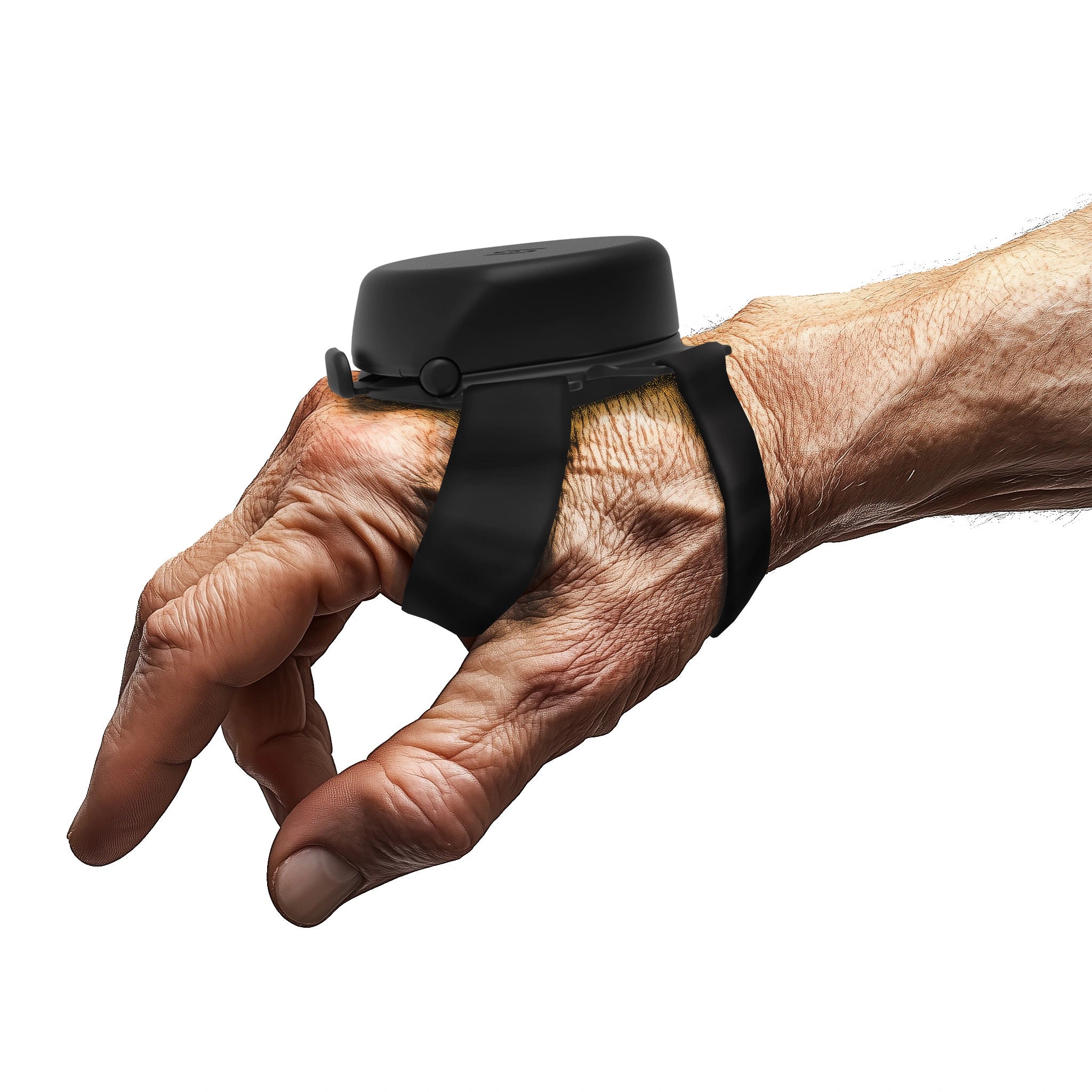
The Steadi-3 Tremor Glove addresses this by stabilizing hand tremor during the specific daily tasks that drive the most emotional distress. Eating, drinking, writing, and grooming. These are not incidental activities. They are the tasks that occur most frequently in social and family contexts, that carry the most visibility, and that produce the most acute embarrassment when tremor is uncontrolled. Reducing tremor during these moments is not about eliminating the condition. It is about preserving the everyday experiences that keep people connected to their identity and their relationships.
This is not offered as an emotional cure. Essential Tremor is a neurological condition, and its emotional dimensions require genuine emotional support, professional help where indicated, and sustained work with the coping strategies described throughout this guide. But the Frontiers finding is clear: the perception of suffering drives burden, and anything that reduces the daily frustration of tremor — through adaptive tools, medication optimization, or skills-based approaches — cascades into reduced suffering, reduced caregiver burden, and improved relational quality.
Using the Steadi-3 as part of a broader Essential Tremor supportive therapy approach, alongside stress management, occupational therapy, mental health support, and community connection, addresses both the physical and emotional dimensions of a condition that is always both.
When to Seek Professional Emotional Support
The emotional experiences described in this guide — embarrassment, social anxiety, depression, caregiver fatigue, relationship strain — are normal responses to an abnormal situation. They do not all require professional intervention. But some patterns of emotional distress cross from normal adjustment into something that warrants direct clinical attention, and recognizing those patterns is important.
For patients, the indicators that professional mental health support is warranted include persistent low mood lasting more than two weeks that does not lift regardless of circumstances; withdrawal from activities you previously valued, particularly when the withdrawal is driven by fear rather than practical difficulty; avoiding leaving the home; persistent feelings of worthlessness or hopelessness that go beyond frustration with the tremor; and increased use of alcohol as a way of managing tremor, anxiety, or social difficulty. Any of these, present for more than a short period, warrants a conversation with a mental health professional.
For caregivers, the indicators include feeling persistently drained or resentful in ways that do not recover with rest; consistently neglecting your own health, medical appointments, or social relationships in service of caregiving; feeling that you cannot take breaks or that doing so would be a betrayal; emotional numbness or a sense of going through the motions without genuine engagement; and feeling trapped or hopeless about the future of the caregiving relationship. These are signs that the caregiver's well-being has been depleted to the point that professional support is required, not more effort.
For couples and families, if the relational strain created by ET is producing conflict, distance, or a fundamental communication breakdown that you cannot navigate through your own resources, couples counseling with a therapist experienced in chronic illness dynamics can help. The specific challenges of ET — the role shifts, the independence-versus-help tension, the caregiver's emotional witness of suffering — respond well to structured therapeutic frameworks that most couples do not have access to on their own.
Starting points for professional support: ask the neurologist for a referral to a psychologist or a licensed clinical social worker experienced in chronic neurological conditions. Contact your primary care physician if the neurologist does not have referrals. Look for therapists who list chronic illness, health psychology, or neurological conditions in their practice descriptions. Many CBT therapists work effectively with ET patients even without specific movement disorder expertise.
Seeking therapy for the emotional impact of Essential Tremor is not a sign that you have handled the condition poorly. It is a recognized and appropriate component of comprehensive tremor management.
How to Talk About Essential Tremor with People Who Don't Understand
The gap between how Essential Tremor feels from the inside and how it reads from the outside is one of the primary sources of emotional distress for ET patients. Strangers misread tremor as nervousness. Colleagues misinterpret visible shaking as a lack of confidence. Friends who have not witnessed a bad tremor episode underestimate the condition's impact. Managing these misperceptions is a continuous, exhausting social task.
Having clear, prepared language reduces this burden. The following frameworks can be adapted to different contexts.
The brief social explanation: "I have a neurological condition called essential tremor. It makes my hands shake when I'm using them. It's not Parkinson's Disease, and it's not caused by being nervous." This covers the most common misunderstandings in two sentences and does not invite extended conversation unless the person wants it.
For family gatherings and extended family: A brief, matter-of-fact disclosure in advance reduces the awkwardness of a visible tremor in real time. "Grandpa's hands shake a lot these days because of a neurological condition he has — it's called Essential Tremor. You might notice it at dinner, but it doesn't hurt, and it's fine to ask him about it if you're curious." Giving extended family explicit permission to ask questions removes the tension of not knowing whether to acknowledge it.
In the workplace, Patients have the right to decide whether and when to disclose. If disclosure is chosen, framing the condition as "a medical condition I manage" rather than "a disability I have" preserves professional self-concept. Practical framing: "I have a hand tremor from a neurological condition — it's well-managed, but I may occasionally need an extra moment with written tasks." Most workplace colleagues respond better to straightforward factual information than to a visible tremor without explanation.
For children and grandchildren: Age-appropriate, calm explanations remove fear and normalize the condition. "Grandma's hands shake because of something in her brain — it's called essential tremor. It doesn't hurt, it's not contagious, and it's just something her body does." Children given a clear explanation typically adapt quickly and follow the adults' emotional cues about whether the condition is alarming.
For detailed guidance, read our guide on how to explain Essential Tremor to friends and loved ones, which covers additional scenarios and language.
Conclusion
Essential Tremor is not a condition that announces itself as devastating. It is quiet in that way. It shows up in the details — the coffee that takes twice as long to drink, the signature that needs explaining, the restaurant that is easier to skip than to navigate. The emotional weight accumulates in those details, invisibly, over months and years.
The research behind this guide makes two things clear. First, the emotional experience of ET — the embarrassment, the social withdrawal, the anxiety, the grief over lost capabilities — is real, documented, and widely shared. You are not being dramatic. You are having a normal response to an abnormal situation. Second, reducing the daily functional burden of tremor cascades directly into emotional relief, not just for the patient but for everyone around them. The physical and emotional dimensions are not separate. Managing one helps the other.
That connection is why the Steadi-3 matters in this context. Not as a fix for what is fundamentally an emotional and relational challenge, but as one practical piece of a larger strategy: reduce the daily moments that produce the most frustration and embarrassment, and the relationship with tremor — and with each other — has more room to breathe.
If you are in the midst of what this guide describes and it resonates with you, find your community. The International Essential Tremor Foundation at essentialtremor.org and the Steadiwear caregiver support hub are starting points. You do not have to figure this out alone, and the people who understand are closer than they may feel right now.