Introduction
The market for wearable tremor devices has grown considerably in recent years, and so has the confusion around it. Different products use fundamentally different technologies — magnetic dampening, gyroscopic stabilization, electrical nerve stimulation, spring-based counterweighting — and each makes claims that are difficult to evaluate without a consistent framework.
Patients and caregivers researching tremor gloves deserve an honest, evidence-grounded comparison that covers technology type, clinical evidence, FDA status, battery requirements, weight, comfort, price, and real-world usability. That is what this guide provides.
Full disclosure: Steadiwear makes the Steadi-3 and is one of the products reviewed here. We have written this comparison anyway, and we have applied the same evaluation criteria to our own product as to every other. If a different device is a better fit for your situation, this guide will help you find it. The goal is to help you make the right decision, not the decision that benefits us.
The evaluation criteria used throughout this comparison are: technology type, clinical evidence, FDA regulatory status, power source, device weight, tremor type compatibility, all-day wearability, price range, return policy, and insurance or FSA eligibility.

The Five Tremor Gloves and Devices Compared in This Guide
This comparison covers the five purpose-built, commercially available anti-tremor glove devices that a patient or caregiver is most likely to encounter when researching hand tremor devices:
Steadi-3 (Steadiwear) uses a magnetic tuned mass damper to generate a battery-free mechanical counterforce against hand tremor. GyroGlove (GyroGear) uses high-speed miniature gyroscopes to resist involuntary hand movement through gyroscopic stabilization. Readi-Steadi is a custom-fitted weighted orthotic glove system developed by an occupational therapist and dispensed with a physician's order. Tremelo (Five Microns) uses a spring-based tuned mass damper in a wearable sleeve. Cala Trio (Cala Health) is a prescription wrist device that uses transcutaneous electrical nerve stimulation to disrupt the brain circuits driving essential tremor.
One additional category, generic weighted fitness gloves, appears frequently in search results for weighted gloves for tremors and is covered separately below. These are standard weighted workout gloves repurposed for tremor and are not purpose-built medical devices.
Steadi-3 by Steadiwear: Magnetic Vibration Absorber Technology
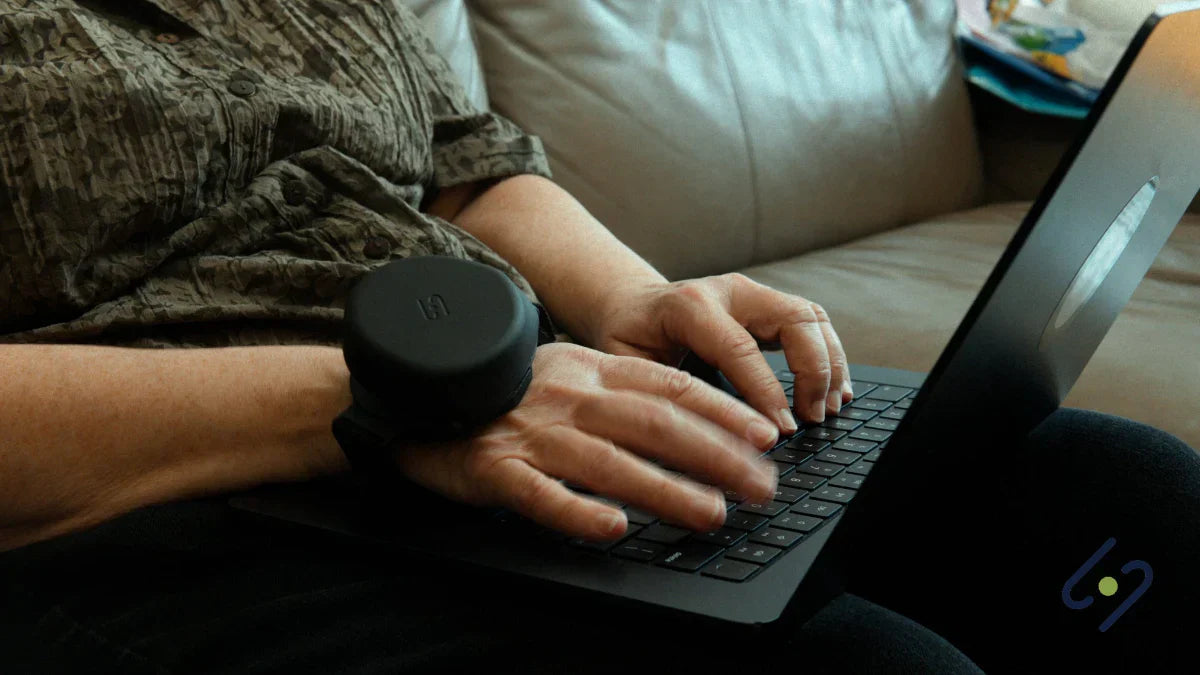
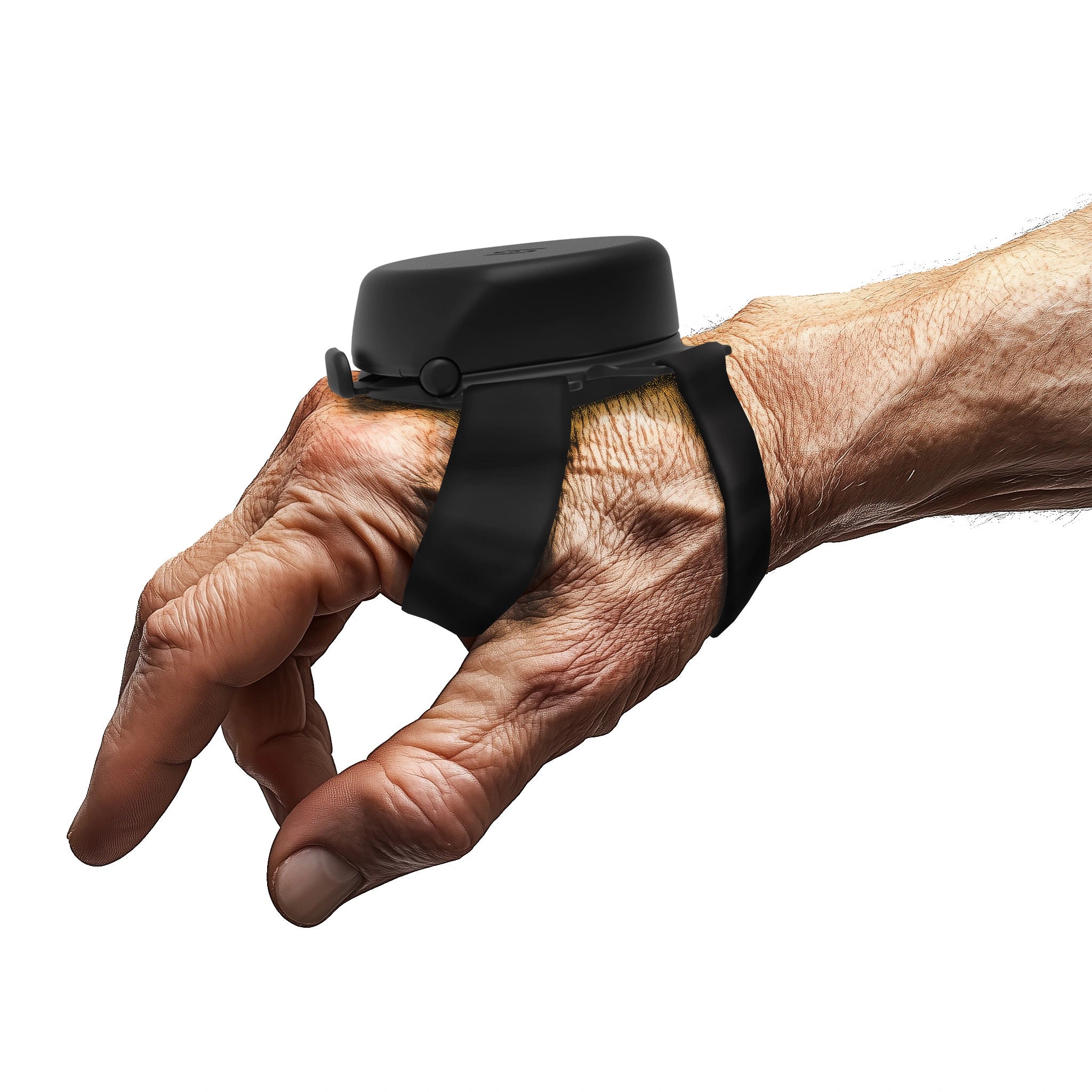
The Steadi-3 uses a tuned mass damper mechanism that operates via magnetic repulsion. A weighted disc inside the device floats within a ring of magnets. When the hand trembles, the disc is repelled in the opposite direction of the movement, generating a continuous counterforce that partially cancels the tremor. Because the entire system is mechanical, with no motors, sensors, or battery, the device responds instantly to any tremor and requires no charging between uses.
The Steadi-3 weighs 275 grams, roughly half the weight of its predecessor, the Steadi-2. It fits in a universal sizing configuration designed to accommodate the range of adult hand sizes without custom fitting.
Clinical evidence: In a controlled evaluation, 84% of participants showed improved tremor control compared to no device. In a blinded assessment in which neurologists evaluated participants without knowing whether they were using the Steadi-3 or a placebo device, participants showed a 70% improvement in tremor control with the Steadi-3 compared with the placebo. This represents meaningful controlled evidence in a device category where independently published clinical data is limited.
FDA status: FDA-registered Class I medical device.
Price: Mid-range. Payment plans through Affirm are available. The Steadi-3 is FSA and HSA-eligible with a letter of medical necessity from a physician. No insurance coverage yet.
Return policy: 30-day hassle-free return, one-year warranty.
Best for: Essential tremor and Parkinson's Disease action tremor. All-day wearability is a strong point given the absence of battery management. The battery-free, frictionless mechanism automatically adapts to changing tremor intensity without adjustment.
Limitations: Less effective for very low-frequency resting tremor that occurs primarily at rest rather than during voluntary movement. Does not address the neurological pathway driving tremor. No current insurance coverage pathway.
GyroGlove by GyroGear: Gyroscopic Stabilization Technology
The GyroGlove embeds miniature gyroscopes that spin at speeds up to 10,000 rotations per minute. A spinning mass resists changes to its orientation through angular momentum and gyroscopic precession, and the GyroGlove applies this principle to resist unwanted hand and wrist movement during daily tasks. When the tremor tries to rotate or tilt the hand, the spinning gyroscopes generate counteracting torques that resist the movement.
GyroGear reports an 85-90% reduction in tremor in internal testing. The device received recognition at CES 2024 in three categories. Its gyroscopic mechanism is particularly relevant for tremor that involves pronation and supination, meaning rotational movement of the wrist, which is a common component of essential tremor and Parkinson's tremor during eating and writing tasks.
Clinical evidence: Manufacturer claims of 85 to 90% reduction. No independently published peer-reviewed clinical study has validated these figures through external evaluation.
FDA status: [INFO REQUIRED — verify current FDA or CE regulatory status for GyroGlove as of 2026.]
Price: Higher-end pricing in the purpose-built tremor device category.
Return policy: 30-day return.
Best for: Moderate to severe tremor, particularly the rotational axis of tremor. Users who want an active counterforce mechanism and are willing to manage battery charging.
Limitations: Requires battery power, with approximately 4 hours of continuous use per charge and 10 hours of intermittent use. Produces an audible whirring sound during operation that some users find distracting. Adds bulk to the hand and wrist relative to passive devices. Battery dependency means the device cannot be worn indefinitely without interruption for charging. No independently published clinical evidence.
Readi-Steadi Orthotic Glove System: Custom Weighted Glove
Readi-Steadi was developed by Krista Madere, an occupational therapist who designed the system specifically for tremor management. It is a custom-molded glove with strategically placed non-toxic weights distributed across the dorsal surface of the hand to counteract tremor by increasing inertia and enhancing proprioceptive feedback. The weight placement is tailored to the individual patient's tremor pattern rather than using a fixed configuration.
Unlike generic weighted gloves, Readi-Steadi is designed by someone with clinical expertise in tremor management, and the fitting process involves OT supervision to ensure optimal weight placement and glove configuration. The system can be adjusted over time as tremor severity changes.
Clinical evidence: No published clinical trial data. The device is supported by occupational therapy practice, physician referrals, and the clinical expertise embedded in its design process.
FDA status: Not FDA-cleared or FDA-registered as a medical device. Available with a physician's order.
Price: Moderate. May be covered by insurance with a prescription, which distinguishes it from most purpose-built tremor devices.
Return policy: [INFO REQUIRED — verify current return or trial policy directly with Readi-Steadi.]
Best for: Patients who want OT-supervised fitting and customized weight placement. Patients who are seeking potential insurance coverage. Patients who can tolerate 24/7 wearability and do not require finger dexterity tasks that the glove may restrict.
Limitations: Requires a physician order and an OT fitting, so it cannot be purchased directly online in all cases without a clinical referral. No published clinical evidence. The added weight carries the same fatigue risk as other weighted systems, particularly during extended daily wear.
Tremelo by Five Microns: Spring-Based Tuned Mass Damper
Tremelo implements the tuned mass damper concept through a spring-based mechanical system. Springs connect counterbalance weights in a wearable sleeve. When the hand trembles, the weights oscillate in the opposite direction of the tremor, absorbing and partially counteracting the shaking energy through the spring mechanism. Like the Steadi-3, it is a battery-free, purely mechanical device.
The key mechanical difference from the Steadi-3's magnetic system is that a spring-based damper must be mechanically tuned to a target frequency range. Springs have a natural resonant frequency determined by their stiffness, and the counteraction is most effective when the tremor falls within that frequency range. Tremor that occurs at frequencies outside the tuned range receives proportionally less counteraction.
Clinical evidence: Manufacturer claims an 85-90% reduction in essential tremor. No independently published peer-reviewed study has validated these figures through external evaluation.
FDA status: [INFO REQUIRED — verify current FDA regulatory status for Tremelo as of 2026.]
Price: Moderate to premium.
Return policy: [INFO REQUIRED — verify current return or trial policy directly with Five Microns.]
Best for: Essential tremor. Battery-free operation makes it suitable for extended wear without requiring charging management.
Limitations: Spring-based frequency tuning reduces adaptability if a patient's tremor frequency shifts over time or varies significantly throughout the day. Limited published clinical evidence. The sleeve format differs from a glove form factor, which may affect usability for tasks requiring full hand and finger access.
Cala Trio by Cala Health: Transcutaneous Electrical Nerve Stimulation
Cala Trio takes a fundamentally different approach from every other device in this comparison. Rather than working at the mechanical level of the hand, it works at the neurological level. The device is a wrist-worn band that delivers precisely calibrated electrical pulses to the median and radial nerves. These nerves connect to the thalamus, the brain region whose abnormal oscillatory activity generates essential tremor. By stimulating these sensory nerves in a specific pattern, Cala Trio disrupts the pathological circuit and provides tremor relief that persists for hours after each therapy session ends.
This mechanism has important practical implications. Cala Trio is used for therapy sessions rather than worn continuously throughout the day. The tremor relief it provides does not require the device to be worn during tasks. A patient completes a stimulation session and then benefits from reduced tremor for a period afterward while wearing nothing on their hand.
Clinical evidence: Strongest in the category. The device was validated in a published study of 205 patients with essential tremor, with a statistically significant improvement in tremor control. Cala Trio holds FDA De Novo clearance for essential tremor, which represents a higher regulatory standard than FDA registration and requires the submission of clinical evidence for review.
FDA status: FDA De Novo cleared for essential tremor — the highest current regulatory standard among the devices compared here.
Price: Subscription model. Requires a physician's prescription for access.
Return policy: [INFO REQUIRED — verify current return or trial policy directly with Cala Health.]
Best for: Essential tremor specifically. Patients who prefer not to wear a device during daily tasks. Patients who are comfortable with a prescription therapy model and session-based use.
Limitations: Prescription required — not available for direct consumer purchase. FDA-cleared for essential tremor only, not Parkinson's tremor. The subscription pricing model means an ongoing cost rather than a one-time purchase. Twice-daily therapy sessions are the recommended protocol and require consistent scheduling. Potential for tingling or skin irritation at the stimulation sites. Contraindicated for patients with implanted electrical devices, including deep brain stimulation systems, cardiac pacemakers, and cochlear implants. Not designed for continuous wear.
Generic Weighted Fitness Gloves: A Budget Alternative?
Search results for weighted gloves for tremors frequently surface generic weighted workout gloves rather than purpose-built anti-tremor devices. Products in this category include HandiThings weighted gloves, Prosource weighted gloves, and various Amazon-listed options priced between $15 and $40.
These are standard fitness accessories, not medical devices designed for tremor management. They distribute weight across the hand and wrist, which can modestly reduce tremor amplitude through the same inertial principle used by purpose-built weighted devices. For a patient with a very mild tremor who wants to experiment inexpensively before investing in a purpose-built device, a generic weighted glove is a reasonable starting point.
The practical differences from purpose-built devices are significant. The weight in fitness gloves is not strategically placed to target the tremor axis, so the damping effect is less precise. These gloves are not frequency-tuned or calibrated for tremor. They may restrict finger dexterity in ways that interfere with the tasks a patient with a tremor is trying to perform. Extended daily wear adds fatigue load. And they carry no clinical evidence, no FDA status, and no OT design expertise.
For mild tremor experimentation, a generic weighted glove is an affordable entry point. For moderate-to-severe tremor, all-day functional use, or tasks requiring preserved finger dexterity, the limitations of non-purpose-built products become meaningful constraints.
Which Tremor Glove Is Best for You? A Decision Framework
The right anti-tremor glove is the one that matches your specific tremor type, severity, lifestyle needs, and practical tolerances. Here is a framework for making that match.
By tremor type:
Essential tremor, which is primarily an action tremor occurring during voluntary movement, responds well to all five purpose-built device categories. Steadi-3, GyroGlove, Tremelo, Readi-Steadi, and Cala Trio all have applications for essential tremor, with Cala Trio holding an FDA indication specifically for ET.
Parkinson's disease action tremor, which occurs during tasks, responds to TMD and weighted approaches. Steadi-3, Readi-Steadi, and GyroGlove are all indicated for or commonly used with Parkinson's tremor.
Parkinson's disease resting tremor, which occurs at rest, is the type least addressed by purely mechanical glove devices. Cala Trio is currently FDA-cleared only for essential tremor, not Parkinson's, though research into FES approaches for Parkinson's resting tremor is ongoing.
By tremor severity:
Mild tremor is well served by generic weighted gloves as an inexpensive first step, or by Readi-Steadi for a more customized, OT-supervised option. Moderate tremor is where purpose-built TMD devices like the Steadi-3 and Tremelo are strongest. Moderate-to-severe tremor may benefit from the more active counterforce of the GyroGlove or the neurological pathway disruption of Cala Trio.
By budget:
Under $50 covers generic weighted fitness gloves. Mid-range pricing covers the Steadi-3 and Tremelo, with payment plans available for the Steadi-3. Premium pricing applies to the GyroGlove. Cala Trio operates on a subscription model and may have insurance pathways. Readi-Steadi may be the most accessible option for patients with insurance coverage, given the physician-order pathway.
By lifestyle and wearability needs:
All-day, battery-free wear favors Steadi-3, Tremelo, and Readi-Steadi. Battery management is required for GyroGlove. Session-based therapy, rather than continuous wear, is the Cala Trio model. For patients who want to wear a device throughout the day without interrupting charging, the battery-free options are a practical advantage.
By evidence preference:
Strongest published clinical evidence: Cala Trio, with a 205-patient study and FDA De Novo clearance. Controlled evaluation with blinded neurologist assessment: Steadi-3. OT-designed with clinical practice support: Readi-Steadi. Manufacturer claims without independent published data: GyroGlove and Tremelo.
No device in this comparison is right for every patient. An occupational therapist evaluation and a conversation with your neurologist are the most reliable path to a device recommendation that fits your specific tremor profile rather than a general profile.
Side-by-Side Specification Comparison
|
Criterion |
Steadi-3 |
GyroGlove |
Readi-Steadi |
Tremelo |
Cala Trio |
|
Technology |
Magnetic TMD |
Gyroscopic stabilization |
Weighted orthotic |
Spring-based TMD |
TENS/nerve stimulation |
|
Power source |
Battery-free |
Rechargeable battery |
Battery-free |
Battery-free |
Rechargeable battery |
|
Device weight |
275g |
Heavier (motor + battery) |
Variable (custom) |
Moderate |
Lightweight wrist band |
|
Tremor types |
ET + PD action tremor |
ET + PD tremor |
ET + PD tremor |
ET |
ET (FDA indication) |
|
FDA status |
Registered Class I |
[INFO REQUIRED] |
Not registered |
[INFO REQUIRED] |
De Novo Cleared |
|
Published clinical evidence |
Yes — controlled, blinded |
No independent data |
No published trials |
No independent data |
Yes — 205-patient RCT |
|
Price range |
Mid-range |
Premium |
Moderate |
Moderate–premium |
Subscription |
|
Return/trial policy |
30-day return |
30-day return |
[INFO REQUIRED] |
[INFO REQUIRED] |
[INFO REQUIRED] |
|
FSA / HSA eligible |
Yes (with LMN) |
[INFO REQUIRED] |
[INFO REQUIRED] |
[INFO REQUIRED] |
[INFO REQUIRED] |
|
All-day wearability |
Yes |
Limited (4hr battery) |
Yes |
Yes |
No (session-based) |
|
Prescription required |
No |
No |
Yes (physician order) |
No |
Yes |
Questions to Ask Your Doctor Before Buying a Tremor Glove
Comparing devices online is a useful starting point, but the most effective device selection happens in collaboration with your neurologist and occupational therapist. Here are the specific questions that will get you the most useful guidance from those conversations.
Is my tremor primarily an action tremor, a resting tremor, or both?
This is the most foundational question. Action tremor and resting tremor have different characteristics and respond differently to different technologies. Your neurologist can assess this during an appointment, and the answer shapes every device recommendation.
What is my tremor frequency?
Different devices are optimized for different frequency ranges. Spring-based TMD systems are tuned to specific frequencies. Magnetic TMD systems respond across a broader band. Knowing your tremor frequency helps match you to the right mechanism.
Do I have any contraindications for electrical stimulation?
If you have a deep-brain stimulation implant, a cardiac pacemaker, a cochlear implant, or another implanted electrical device, FES-based options like Cala Trio are contraindicated. Your neurologist will know this, but it is worth raising explicitly in the context of tremor device research.
Would I benefit from an OT-supervised fitting?
For devices like Readi-Steadi, OT supervision is part of the dispensing process. For other devices, an OT evaluation can optimize fit, weight placement, and usage strategies regardless of which device you choose. If an OT referral is not already part of your care, this conversation is the right moment to request one.
Should I try a wearable device alongside my current medication, or in the context of adjusting my dosage?
Tremor devices are not replacements for pharmacological management, but they can provide meaningful supplemental control. Your neurologist can advise on how to integrate a wearable device into your current treatment plan and whether your medication management has room for adjustment that might affect your device needs.
Does my insurance cover any wearable tremor devices?
Ask your neurologist to document medical necessity for the device you are considering, and contact your insurer directly with the specific product code. Coverage is evolving as clinical evidence accumulates, and a letter of medical necessity from a physician is the key document for any coverage request.
Conclusion
No single tremor glove is best for every patient. The right choice depends on your specific tremor type and severity, lifestyle, and how you want to manage battery life, device bulk, clinical evidence, and cost. That is why this guide presents an honest comparison rather than a ranked list — because the factors that make one device the right fit for you may make it the wrong fit for someone else.
What the comparison makes clear is that this is an active and improving category. Battery-free mechanical devices, prescription nerve stimulation therapy, and gyroscopic stabilization all have a place in it, and the clinical evidence base is growing.
If you are considering the Steadi-3, the 30-day return policy means there is no pressure to commit. Try it during your actual daily routine — mealtimes, writing tasks, whatever activity the tremor affects most. The answer to whether it works for you is in the experience, not the spec sheet. Start at the Steadi-3 product page, and involve your neurologist or occupational therapist in the decision if you have not already.