Living with Parkinson's Disease means navigating a condition that changes over time. Motor symptoms such as tremor, stiffness, freezing of gait, and reduced dexterity do not remain constant. They evolve. And the tools that help someone maintain independence need to evolve alongside them.
This guide covers the full landscape of assistive devices for Parkinson's Disease, organized by daily living category. Whether you are newly diagnosed, several years into managing symptoms, or a caregiver helping a loved one stay as independent as possible, you will find practical, specific information here. That includes what types of adaptive equipment for Parkinson's are available, when to introduce each, and how to consider cost and insurance coverage.

Why Assistive Devices Matter for People Living with Parkinson's
Parkinson's Disease affects movement in multiple ways simultaneously. Tremor makes it hard to hold utensils or fasten buttons. Rigidity slows transitions between positions. Freezing of gait creates sudden, unpredictable pauses in movement. Dyskinesia, which is involuntary movement often linked to medication timing, adds another variable to manage.
These motor symptoms affect everyday tasks. Getting dressed, eating a meal, taking a shower, and walking to the kitchen. The cumulative effect is not just physical difficulty. It is the gradual erosion of the confidence and autonomy that most people take for granted.
Assistive devices for Parkinson's Disease do not reverse the condition. What they do is reduce the friction between a person's intention and their ability to act on it. They make daily tasks safer, less fatiguing, and more manageable without constant caregiver assistance.
One important point from the Parkinson's Foundation: do not wait until a crisis to start exploring adaptive equipment for Parkinson's. Introducing devices early, when a person still has a strong capacity to learn and adapt to new tools, produces far better outcomes than scrambling after a fall or a significant decline. The earlier someone works with an occupational therapist or physical therapist to assess their needs, the more options they have and the better each device will fit.
An occupational therapist is particularly valuable here. They assess how Parkinson's is affecting a person's specific daily tasks and recommend devices tailored to those needs. A generic list is a starting point. A therapist turns that list into a personalized plan.
Mobility Aids and Assistive Devices for Gait in Parkinson's Disease
Mobility challenges are among the most visible effects of Parkinson's disease. Gait changes, balance problems, and freezing episodes create real fall risk. Choosing the right mobility aid matters because not all walking devices work the same way for Parkinson's patients.
Straight canes are appropriate for mild balance issues, but have an important caveat for Parkinson's: the standard four-footed quad cane is generally not recommended. The lift-and-place motion required to advance a quad cane disrupts the walking rhythm that Parkinson's patients already struggle to maintain.
Four-wheeled rollators with braking systems are the most widely recommended walker option for Parkinson's. Because they move continuously without requiring the user to lift them, they support a more natural walking cadence. Look for models with hand brakes, a seat for resting, and a storage basket.
Walking poles can help with posture and stride length in earlier stages, particularly for patients who are still active and want to maintain their fitness routine.
Wheelchairs and motorized scooters become relevant in advanced stages when walking is no longer safe or sustainable. A physical therapist can help assess the right configuration to support proper seating posture and reduce secondary complications.
How Visual and Auditory Cueing Devices Help with Freezing of Gait
Freezing of gait is one of the most disabling symptoms in Parkinson's Disease. A person is mid-step and suddenly cannot move. Standard walking aids do not help with this. Specialized cueing devices do.
Laser canes project a horizontal line onto the floor in front of the user. That visual line gives the brain a target to step over, which can break the freeze and restart walking. Clinical research supports visual cueing as one of the most effective strategies for reducing freezing episodes, and the Parkinson's Foundation includes it among its recommended assistive devices for gait in Parkinson's disease.
Auditory cueing devices, including wearable metronomes and smartphone apps, deliver a rhythmic beat that helps Parkinson's patients pace their steps. The external rhythm compensates for the internal timing disruption caused by the condition.
Physical and occupational therapists trained in Parkinson's care can teach cueing techniques and help select the right device. The combination of a proper walking aid and a cueing strategy is almost always more effective than either approach alone.
Adaptive Eating and Kitchen Equipment for Parkinson's Patients
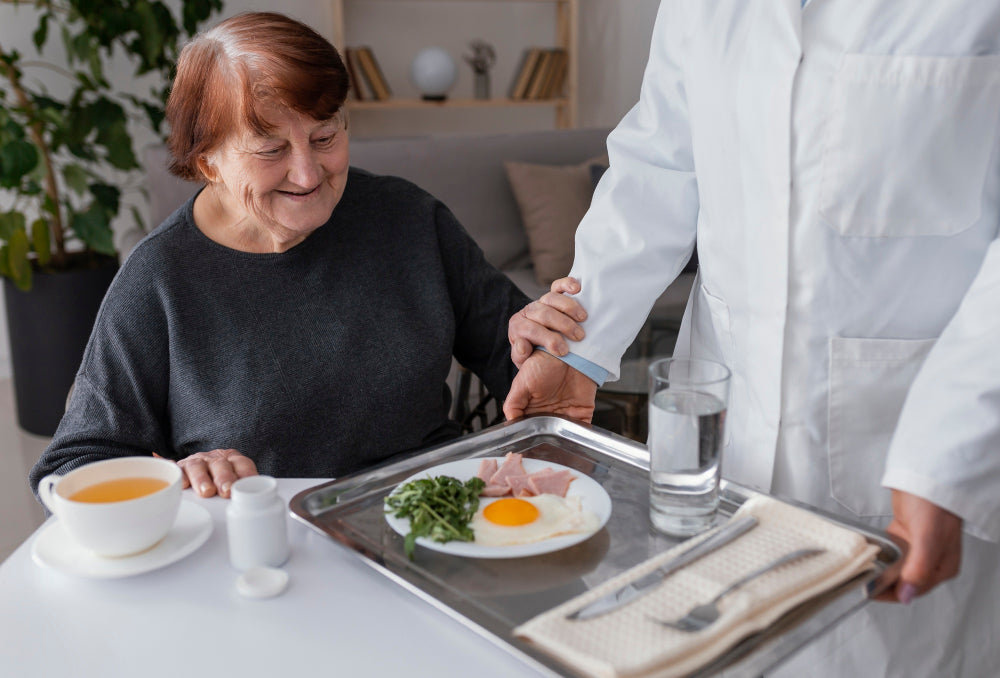
Mealtime is one of the earliest areas where tremor and reduced grip create visible frustration. Spilled drinks, dropped utensils, and the exhaustion of trying to maintain control through a full meal erode both nutrition and dignity. Parkinson's disease adaptive equipment for eating has advanced considerably in recent years.
Weighted and built-up handle utensils are the most common starting point. Extra weight in the handle can counteract some tremor, and a thicker grip requires less fine motor control. Many occupational therapists recommend these as a first step.
Swivel utensils rotate at the bowl or head of the spoon to stay level regardless of wrist movement. They are particularly helpful for soups and cereals where spillage is a significant problem.
Rocker knives allow one-handed food cutting with a curved rocking motion, eliminating the need for a stabbing-and-sawing technique that requires coordination between both hands. Paired with an adaptive cutting board featuring corner guards and non-slip feet, they considerably extend kitchen independence.
Non-slip mats, scoop plates, and two-handled cups address the full picture of a mealtime setup. Scoop plates have a raised inner edge so food can be pushed against it and scooped onto a utensil without the plate moving. Two-handled cups allow a steadier, more distributed grip.
Tremor-stabilizing utensils, such as Liftware Steady, represent a more active category of eating aids. These electronic spoons and forks use sensors to detect and counteract involuntary hand movement in real time, keeping the utensil level even when the hand is not. For patients with moderate to significant tremor, independent eating can be meaningfully extended and should be considered as part of a comprehensive adaptive equipment strategy.
Dressing Aids and Adaptive Clothing for Parkinson's
Getting dressed is a task that requires fine motor control at nearly every step: buttons, zippers, laces, and pulling socks on. For Parkinson's patients, reduced dexterity and tremor can turn a routine activity into a source of daily frustration.
Button hooks and weighted button aids allow someone to fasten standard buttons with one hand or with reduced grip strength. They take some practice but are widely used and low-cost.
Zipper pulls attach to existing zippers and extend them into a loop or handle that is much easier to grip. Magnetic closure shirts eliminate the zipper challenge entirely by using hidden magnets that look identical to standard shirt closures when worn.
Elastic and Velcro shoe alternatives are among the most impactful dressing aids for Parkinson's patients. Tying laces requires fine motor control and a stable posture, both of which are often compromised. Velcro shoes, elastic laces, and slip-on styles with heel support remove that challenge without requiring a wardrobe overhaul.
Long-handled shoehorns and sock aids allow people to put on footwear without bending deeply, which is also relevant for patients managing postural instability.
Several adaptive clothing brands now offer Parkinson 's-friendly garment designs, including shirts with magnetic closures, pants with elastic waistbands styled to look standard, and footwear designed for ease of donning without sacrificing appearance. An occupational therapist can recommend specific brands based on a patient's individual limitations.
Bathroom Safety and Personal Grooming Devices
The bathroom is the highest-risk environment for falls in the home, and Parkinson's disease significantly increases that risk. Wet surfaces, transitions between standing and sitting, and the balance demands of showering all require attention.
Grab bars are the foundational bathroom safety modification for patients with Parkinson's. Properly installed grab bars near the toilet, tub entry, and shower area provide stable points of support during critical transitions. They must be anchored into wall studs or with appropriate anchors. Towel bars are not a substitute.
Non-slip mats, both inside and outside the shower or tub, reduce the risk of falls on wet surfaces. Handrails in the tub area and along walls provide additional security.
Shower chairs and transfer benches allow patients to bathe seated rather than standing. Transfer benches extend over the tub edge, allowing a person to sit on the bench outside the tub and slide across without lifting a leg over the edge, which is particularly important for patients with balance issues.
Raised toilet seats with armrests make it significantly easier for patients with leg stiffness or weakness to stand from a seated position. The armrests provide push-off points that reduce the strength and coordination required.
For personal grooming, electric toothbrushes require far less fine motor control than manual brushing and generally produce better hygiene outcomes for patients with tremor. Electric razors eliminate the precision demands of a blade razor and significantly reduce the risk of cuts. Hands-free faucets and soap dispensers reduce the number of grip-and-turn actions required and can be installed as part of a broader home modification plan.
Communication and Speech Assistive Technology
Parkinson's Disease commonly causes hypophonia, which is a reduction in voice volume that can make speech difficult to understand. This symptom is often underaddressed because patients and caregivers gradually adapt to it without recognizing its impact on communication and social participation.
Voice amplifiers are wearable or portable devices that amplify speech through a small speaker. They are particularly useful in social settings, group environments, or situations with background noise. A speech-language pathologist can help select and fit the right model.
Speech-to-text applications allow Parkinson's patients to compose text, emails, and messages by speaking rather than typing, which addresses both voice projection challenges and reduced typing ability. Modern smartphone applications have become highly accurate and require minimal setup.
Eye-tracking technology is relevant for advanced-stage Parkinson's, where verbal and motor communication are significantly impaired. These systems allow a user to control a screen and communicate by tracking eye movement, enabling meaningful interaction even with very limited physical mobility.
The role of a speech-language pathologist should not be underestimated here. They assess the specific nature of a patient's speech challenges, which vary considerably across individuals, and recommend both device options and therapy approaches that work together. The Lee Silverman Voice Treatment (LSVT LOUD) program, for example, is an evidence-based speech therapy approach specifically developed for Parkinson's that a speech-language pathologist administers. Assistive devices work best when they complement, not replace, professional speech support.
Home Safety and Smart Technology for Parkinson's
Beyond individual devices, the home environment itself can be adapted to support safety and independence. A combination of structural modifications and smart home technology creates a more predictable, manageable living space for Parkinson's patients.
Voice-activated smart home devices reduce the need for fine motor control across lighting, temperature, music, reminders, and communication. A patient who cannot easily navigate a phone touchscreen can speak a command instead. These systems are widely available, relatively affordable, and can be configured to work with existing home setups.
Medical alert systems and wearable emergency buttons provide a safety net for patients who spend time alone. If a fall occurs when no caregiver is present, the ability to immediately contact emergency services can be life-saving. Some systems include automatic fall detection that does not require the user to press a button.
Automatic pill dispensers and medication reminder apps address one of the most consequential daily management challenges in Parkinson's. Medication timing is critical for managing symptoms, and missing doses or taking them off schedule can have significant functional consequences. Automated dispensers release the correct dose at the correct time and can alert caregivers if a dose is missed.
Bed rails, bed cradles, and floor-to-ceiling grab bars support safe transitions in and out of bed, which become progressively more difficult as Parkinson's affects trunk mobility and leg strength. These are some of the most underutilized adaptive equipment options and among the most impactful for nighttime safety.
Fall detection technology has expanded significantly. Wearable sensors, home-based radar systems, and even smart floor mats can detect falls and automatically alert caregivers. For patients living alone or with a caregiver who is not always present, these systems provide meaningful added safety.
How Steadiwear Helps Parkinson's Patients Regain Independence
Many of the devices covered in this guide address the physical environment around a Parkinson's patient. Grab bars stabilize the bathroom. Rollators stabilize walking. Adaptive utensils make eating easier. But for patients whose primary challenge is hand tremor, these passive aids have a ceiling. They reduce the difficulty of tasks, but they do not address the tremor itself.
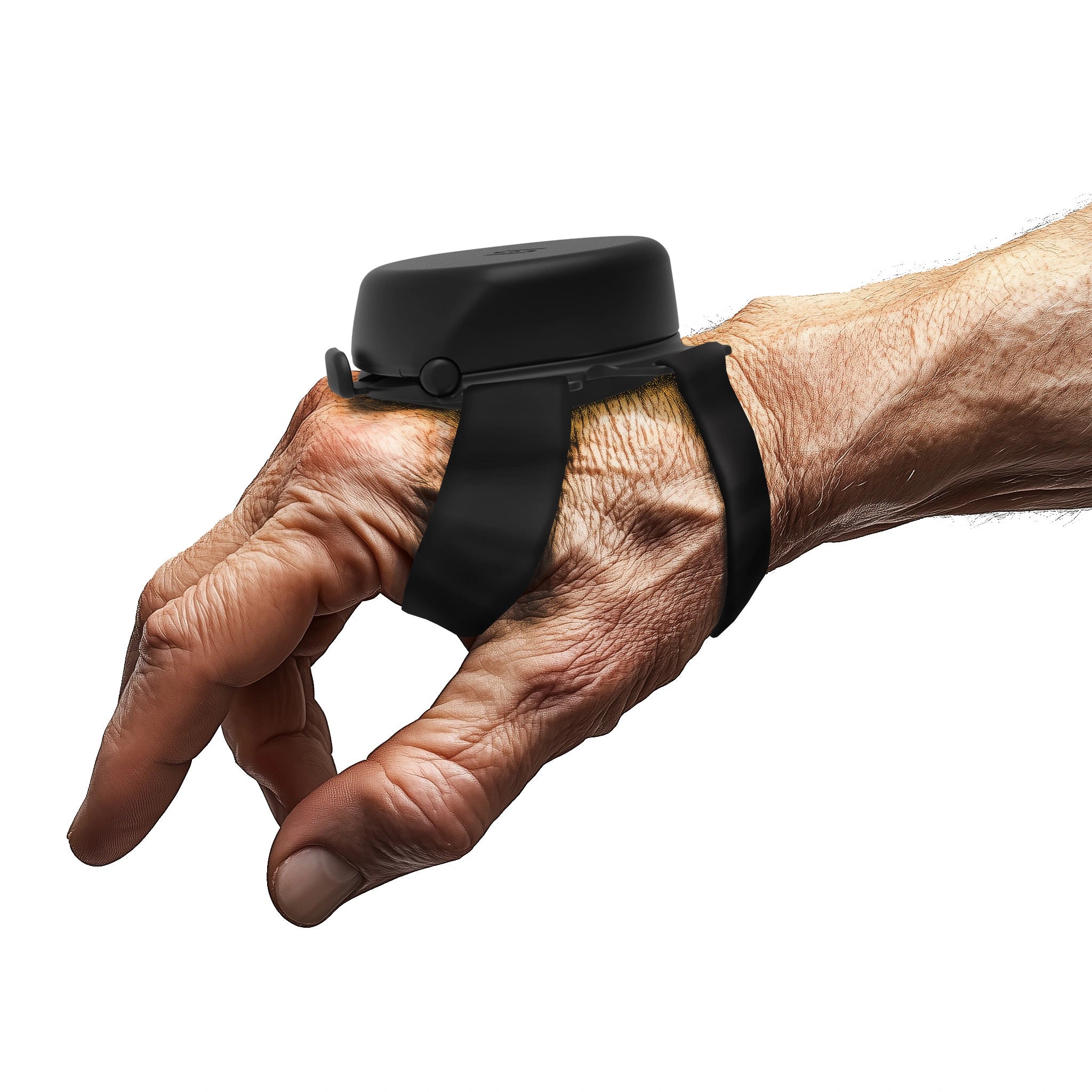
That is the distinction that active tremor stabilization technology makes. The Steadi-3 Tremor Glove from Steadiwear uses patented magnetic dampening technology to counteract involuntary hand movement in real time. It is battery-free, weighs 290 grams, and is designed to be worn during daily activities rather than only in controlled settings. There are no wires, no charging cables, and no electronics that require maintenance or replacement.
For Parkinson's patients, the impact is most evident during tasks that require sustained hand control: eating a meal, writing by hand, grooming, and pouring a drink. These are exactly the moments where weighted utensils and adaptive grips reach their limits. Weighted tools can slightly reduce visible tremor, but they increase fatigue and do not scale with tremor severity. Active tremor stabilization technology works differently, engaging with the movement itself rather than simply adding mass.
The Steadi-3 is most effectively introduced as part of a broader assistive device strategy. A patient might use a rollator for mobility, a shower bench and grab bars in the bathroom, adaptive utensils for some tasks, and the Steadi-3 for activities that require fine motor hand control. Working with an occupational therapist to integrate the glove into an overall daily routine yields the best outcomes, as the therapist can identify the specific tasks where tremor stabilization will have the greatest impact.
Real-world use cases include mealtimes when patients want to eat independently and with dignity, writing tasks such as signing checks or writing greeting cards, and grooming activities such as applying makeup or shaving. In each case, the Steadi-3 addresses something that no other assistive device in this guide addresses: the tremor at its source.
Choosing the Right Assistive Device by Parkinson's Disease Stage
One of the most common frustrations patients and caregivers have when researching assistive devices for Parkinson's Disease is that most guides present everything as a flat list. The result is information overload. The better question is: what do you need now, at this stage of the condition?
Parkinson's Disease is staged using the Hoehn and Yahr scale, which ranges from Stage 1 (mild, one-sided symptoms) to Stage 5 (requiring full-time assistance). The following framework maps device categories to general disease stages. Individual needs vary, and an occupational therapist or physical therapist should confirm the right options for each person.
Early stage (Hoehn and Yahr 1 to 2): This is the window to build good habits and introduce tools before they are urgently needed. Walking sticks for mild balance support, adaptive utensils for tremor at mealtimes, Velcro shoe alternatives for ease of dressing, and voice amplifiers if speech volume is beginning to decrease. Tremor-stabilizing wearables like the Steadi-3 can and should be introduced as soon as tremor affects daily tasks, rather than waiting until it becomes severe.
Mid stage (Hoehn and Yahr 2.5 to 3): Balance impairment becomes more significant, and fall risk increases. Four-wheeled rollators replace or supplement canes. Laser canes are introduced if freezing of gait is occurring. Shower chairs, grab bars, and raised toilet seats become priorities. Smart home technology and automatic medication dispensers reduce the daily management burden. Tremor stabilization remains relevant across this stage.
Advanced stage (Hoehn and Yahr 4-5): Wheelchairs and motorized scooters for mobility. Eye-tracking communication devices if verbal communication is significantly impaired. Hospital-grade bed positioning aids and full home modification. Caregiver involvement in device fitting and daily use is essential at this stage. An occupational therapist assessment at each stage transition ensures that the device plan keeps pace with the condition.
The single most important principle: reassess. Parkinson's is progressive. A device plan that worked at one stage will become insufficient as the condition advances. Building a relationship with an occupational therapist and scheduling reassessments, especially after a significant change in function, is the practice that keeps adaptive equipment aligned with actual needs.
Insurance, Cost, and Where to Buy Parkinson's Assistive Devices
Cost and insurance coverage are among the most frequently searched topics when patients and caregivers begin researching adaptive equipment for Parkinson's, and among the least covered by existing guides. Here is what you need to know.
Which devices require a prescription: Certain categories of durable medical equipment, including walkers, wheelchairs, hospital beds, and lift chairs, require a physician's prescription for insurance reimbursement. A neurologist or primary care physician can provide this. Adaptive utensils, grooming aids, and most home safety modifications are generally purchased out of pocket.
Medicare coverage basics: Medicare Part B covers durable medical equipment with a physician's prescription when the equipment is deemed medically necessary. This can include rollators, wheelchairs, and certain communication devices. Not all equipment qualifies, and suppliers must be Medicare-approved. Contact Medicare directly or ask your neurologist's office for a referral to a Medicare-enrolled supplier.
The U.S. Assistive Technology Act: Each state operates an Assistive Technology Program funded under the federal Assistive Technology Act. These programs offer device demonstrations, short-term lending that allows people to try devices before purchasing, and, in some cases, financing options for device purchases. The program in your state can be found through the Association of Assistive Technology Act Programs (ATAP).
Price ranges by category: Mobility aids range from under $30 for a basic cane to $300-$800 for a quality rollator and $2,000 or more for a motorized scooter. Adaptive utensil sets typically cost $20 to $60. Laser canes range from $50 to $200. Smart home devices vary widely. Tremor-stabilizing wearables are a different category from medical-grade devices, and Steadiwear offers financing options and a 30-day money-back guarantee to reduce purchase risk.
Where to buy: Medical supply stores carry many standard categories. Online retailers, including Amazon, offer adaptive utensils, dressing aids, and bathroom safety equipment. Specialty Parkinson's vendors and occupational therapy suppliers carry a wider range of clinical devices. Your occupational therapist can provide specific supplier recommendations based on what they know works reliably in practice.
Conclusion
Living well with Parkinson's Disease is not about finding a single solution. It is about building a layered system that meets you where you are, adapts as the condition progresses, and protects the daily moments that matter most.
The devices and strategies covered in this guide span mobility, eating, dressing, communication, and home safety, as Parkinson's affects all of these areas. No single tool solves everything. But the right combination, assembled with guidance from an occupational therapist and revisited at each stage transition, can extend independence, reduce fall risk, and preserve the quality of daily life in meaningful ways.
If hand tremor is one of your primary challenges, the Steadi-3 fits into this broader strategy as the component that addresses what passive adaptive tools cannot: the tremor itself. Used alongside a rollator for mobility, adaptive utensils for meals, and grab bars in the bathroom, it completes a daily living toolkit that covers the full picture.
Your neurologist and occupational therapist are the right partners for building and evolving your plan. The resources on Steadiwear's page on adaptive equipment for Parkinson's can help you continue the conversation.