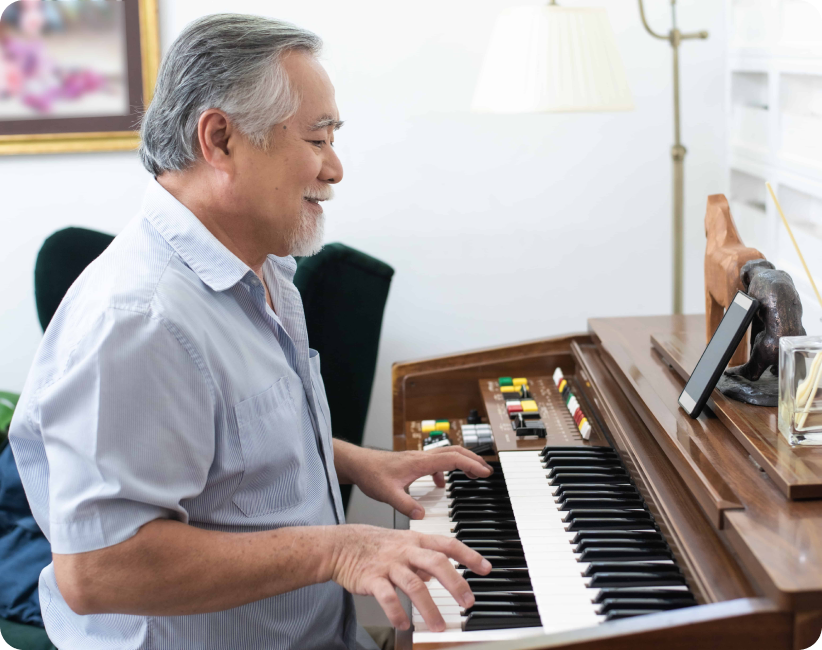
Playing Piano with Parkinson's Disease

Music is a powerful form of therapy, self-expression, and emotional release. For individuals living with Parkinson’s Disease, the piano offers a way to stay engaged with both the mind and the body.

The Challenges of Playing Piano with Parkinson’s Disease

Parkinson’s Disease is a progressive neurological disorder that often affects fine motor skills, muscle control, and coordination. These symptoms pose unique challenges at the piano. Common issues include tremors in the hand or fingers, rigidity in the wrists, and slowed or unpredictable movements. Over time, these changes can lead to frustration or even abandonment of musical practice. While every individual experiences Parkinson’s differently, recognizing the specific impact of the condition on piano playing is a critical step. With the right support, playing piano with Parkinson’s Disease remains possible—and rewarding—for many.

How Pianists Adapt to Parkinson’s Symptoms

Musicians living with Parkinson’s Disease often turn to modified techniques and adaptive strategies to continue playing. Some shift their focus to slower compositions that allow more control. Others simplify complex passages, play one hand at a time, or switch to digital keyboards with touch-sensitive keys. Exercises that target finger strength and flexibility can also help sustain playing ability. Importantly, assistive tools such as hand stabilizers—like the Steadi-3 Plus—have emerged as a safe and effective option for improving wrist control. These supports can make playing piano with Parkinson's Disease more comfortable and more consistent, helping players reconnect with their musical abilities.

Playing Piano with Parkinson's Disease Made Easier

Testimonials

From Spills to Stability “Essential Tremor affects my daily life—writing, eating, even drinking. With Steadi-3 Plus, I feel more confident, in control, and no more spills on my shirt! I’d 100% urge anyone with Essential Tremor to give this a try.”

John S.

Why Choose Steadi-3 Plus for Playing Piano with Parkinson’s Disease

Stabilizes wrist tremors
naturally and in real time

Timothy

"The Steadi-3 Plus uses patented magnetic damping technology to respond dynamically to tremor activity. Unlike electric or motorized devices, it works passively—meaning no charging or setup is required. This allows users to immediately experience more stable hand movement during repetitive tasks like scales and arpeggios. When playing piano with Parkinson’s Disease, reducing excess wrist motion can help restore confidence and rhythm at the keyboard."

Enables smoother, more predictable movement

Parkinson’s tremors and motor symptoms often cause unpredictability in wrist and hand motion. The Steadi-3 Plus offers a gentle stabilizing effect that guides the wrist through a more consistent range of movement without limiting finger articulation. This can significantly improve performance when tackling intricate musical passages or maintaining timing across both hands while playing piano with Parkinson’s Disease.

Reduces fatigue during long practice sessions

The ergonomic glove is designed with comfort and breathability in mind, allowing users to practice for longer periods without additional strain. For pianists who are determined to stay active despite Parkinson’s-related fatigue, Steadi-3 Plus provides subtle but sustained support. This helps reduce physical stress on the forearm and wrist, which is especially valuable during longer rehearsals or performances involving playing piano with Parkinson’s Disease.

Preserves musical expression and technique

While the Steadi-3 Plus assists with wrist stabilization, it does not interfere with nuanced finger movement—making it ideal for musicians who need to preserve their expressive control. Players can still shape dynamics, phrasing, and articulation naturally, while benefiting from increased stability. This balance is essential when playing piano with Parkinson’s Disease, where artistic expression should never be compromised by physical limitations.