Anti-Tremor Glove: Complete Buying Guide
An anti tremor glove is a wearable device designed to reduce the amplitude of involuntary hand shaking caused by Essential Tremor, Parkinson's Disease, or other neurological conditions. The category spans several technologies, including passive weighted, passive magnetic, gyroscopic, and neurostimulation, that work differently and suit different tremor profiles, severity levels, and daily use needs. There is currently no cure for Essential Tremor or Parkinson's Disease; an anti-tremor glove is a management tool that supports daily independence and control.

What is an anti-tremor glove and how does it work?
An anti-tremor glove is a wearable assistive device worn on the hand, wrist, or forearm that uses mechanical, magnetic, gyroscopic, or neurostimulation technology to reduce the amplitude of involuntary shaking. All anti-tremor gloves target the same goal: enabling more precise hand movement during daily tasks such as eating, writing, drinking, and using a phone. But they do so through fundamentally different mechanisms. Anti-tremor gloves do not treat the neurological condition driving the tremor; they reduce its physical expression at the level of the hand.
The three main types of anti-tremor glove technology
Passive mechanical devices add weight or a reactive internal mass to reduce tremor amplitude without electronics. Magnetic tuned mass damper devices like the Steadi-3 use a vibration-absorbing disc that moves in opposition to the tremor; both types are battery-free. Active gyroscopic devices use a spinning gyroscope to generate angular momentum that resists involuntary hand movement; they require battery power. Neurostimulation wristbands deliver calibrated electrical pulses to peripheral nerves; the Cala Trio holds FDA De Novo clearance for Essential Tremor and requires a prescription.
Anti-tremor gloves for Essential Tremor vs. Parkinson's Disease
Essential Tremor produces action tremor during voluntary movement like writing, eating, or lifting; anti-tremor gloves are most effective for this tremor type because the stabilization benefit is applied during the same motions that produce the shaking. Parkinson's Disease involves both resting tremor and action tremor; mechanical anti-tremor gloves are most effective for the action component and less effective for resting tremor. The Steadi-3 is used for both Essential Tremor and Parkinson's Disease action tremor. Cala Trio holds FDA De Novo clearance for Essential Tremor only. A neurologist or movement disorder specialist is best positioned to guide device selection.
Key criteria for choosing an anti-tremor glove
Tremor type and severity determine which technology category applies before any device is shortlisted. Power source matters: battery-free devices can be worn continuously; battery-powered devices require charging; neurostimulation devices are used in timed therapy sessions. Clinical evidence quality varies: distinguish manufacturer-reported outcomes from placebo-controlled, blinded assessments; the Steadi-3 is supported by a placebo-controlled study in which 84% of users showed improved tremor control. Regulatory status varies: FDA-registered versus FDA De Novo cleared versus no FDA designation are meaningfully different.
The Steadi-3: Steadiwear's passive magnetic anti-tremor glove
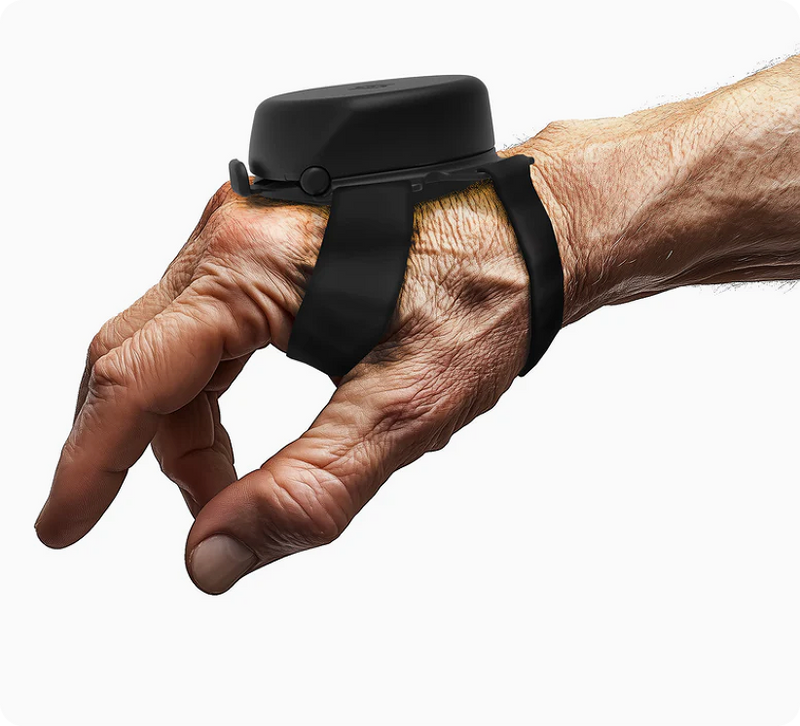
The Steadi-3 is Steadiwear's purpose-built anti-tremor glove: an FDA-registered Class I medical device that uses passive magnetic stabilization through a tuned mass damper; a vibration-absorbing disc moves in opposition to the tremor without batteries, electronics, or charging. In a placebo-controlled study, 84% of users showed improved tremor control; blinded neurologist assessments confirmed 70% improvement over a placebo glove. Designed for all-day wear; universal adjustable fit; available for either hand or both hands. The Steadi-3 Plus features replaceable straps at $49.99.
Anti-tremor gloves vs. other tremor management approaches
Medication, most commonly propranolol and primidone for Essential Tremor, is typically the first-line management approach; anti-tremor gloves are non-pharmaceutical and can be used alongside medication in consultation with a healthcare provider, not instead of it. Surgical options including deep brain stimulation and focused ultrasound thalamotomy are available for selected severe cases; anti-tremor gloves are not a substitute for surgical evaluation when that discussion is clinically appropriate. Anti-tremor gloves offer a non-invasive, non-pharmaceutical option for individuals who have not achieved sufficient tremor control with medication.
How to know if your anti-tremor glove is working
The primary indicator that an anti-tremor glove is working is improved performance on the specific daily tasks the tremor disrupts most: eating, writing, drinking, using a phone. Look for reduced spillage, steadier handwriting, or improved grip. Give the device a structured evaluation period of at least two to four weeks during consistent daily use; tremor severity fluctuates with fatigue, stress, caffeine, and medication timing, so a single day's observation is not a reliable baseline. An occupational therapist can administer standardized hand function assessments before and after a trial period to provide objective measurement.
Frequently Asked Questions
What is the best anti-tremor glove for Essential Tremor?
The right anti-tremor glove for Essential Tremor depends on tremor severity, lifestyle, and whether the reader can manage battery charging, requires a prescription, or wants to pursue FSA/HSA reimbursement. For battery-free all-day wear with controlled clinical evidence and no prescription requirement, the Steadi-3 is an FDA-registered Class I medical device in which 84% of users showed improved tremor control in a placebo-controlled study. For the strongest independently published clinical evidence and FDA De Novo clearance for Essential Tremor, Cala Trio meets the highest regulatory standard, though it requires a prescription. Consult a neurologist or occupational therapist.
Does an anti-tremor glove work for Parkinson's Disease?
Anti-tremor gloves can provide meaningful benefit for Parkinson's Disease action tremor, the shaking that occurs during intentional movement such as eating, writing, and drinking. Parkinson's Disease also involves resting tremor, which occurs when the hand is at rest and often decreases during movement; passive mechanical anti-tremor gloves are less effective for resting tremor. The Steadi-3 is designed for use in both Essential Tremor and Parkinson's Disease action tremor. Cala Trio is FDA De Novo cleared for Essential Tremor only. A movement disorder neurologist is the most reliable source of device guidance for Parkinson's Disease, given the variability of tremor presentation across patients.
Is the Steadi-3 an FDA-approved anti-tremor glove?
The Steadi-3 is an FDA-registered Class I medical device; FDA registration means the manufacturer is registered with the FDA and the device meets Class I safety and labeling requirements with ongoing FDA oversight. FDA registration is not the same as FDA clearance or FDA De Novo clearance, which require pre-market submission of clinical evidence; among tremor devices, Cala Trio holds FDA De Novo clearance for Essential Tremor, the highest current regulatory standard. FDA registration still meaningfully distinguishes the Steadi-3 from generic weighted fitness gloves, which carry no FDA designation.
How much does an anti-tremor glove cost?
Generic weighted fitness gloves range from $15 to $40 and are the lowest-cost entry point, though they are not purpose-built medical devices. Purpose-built passive mechanical devices including the Steadi-3 sit in a mid-range price category; Affirm financing is available for the Steadi-3, and the device is FSA and HSA eligible with a letter of medical necessity from a physician. Active gyroscopic devices are priced at the premium end of the category. Neurostimulation devices like Cala Trio operate on a subscription model with prescription access.
Can I use an anti-tremor glove alongside my tremor medication?
Yes; anti-tremor gloves are non-pharmaceutical wearable devices that do not interact with tremor medications such as propranolol or primidone in the way drugs interact with each other. Many patients use an anti-tremor glove as a complementary tool alongside medication, particularly for tasks where medication provides insufficient tremor control. The Steadi-3 uses passive magnetic stabilization with no electronic components; however, patients with implanted cardiac devices such as pacemakers should consult their cardiologist before using any device with magnetic components.