
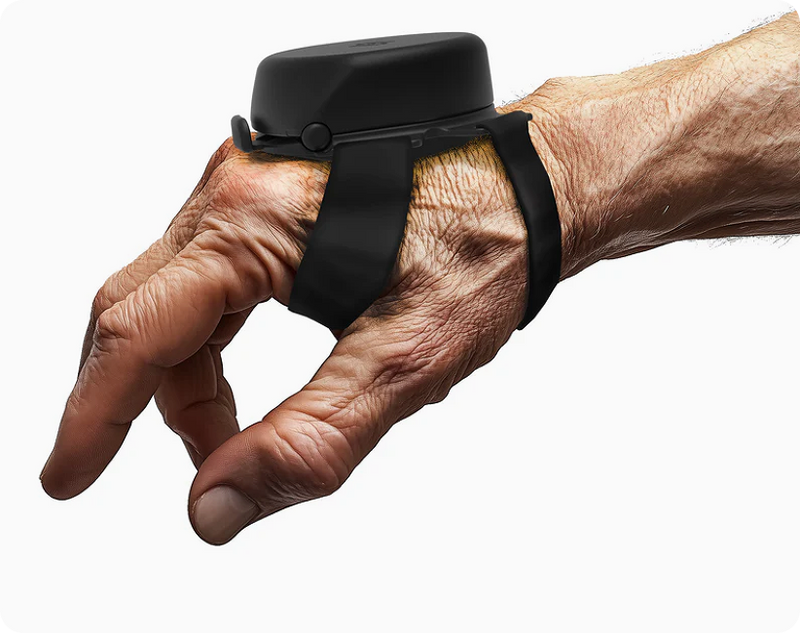

Tremor Devices Not Currently Covered by Medicare
Not all tremor devices qualify for Medicare coverage, even if they are FDA-registered or supported by clinical research. To qualify for Medicare DME coverage, a device must meet strict criteria, including medical necessity, a defined DME category, and sufficient clinical and utilization evidence reviewed through a CMS National or Local Coverage Determination (NCD or LCD). This approval process can take years, particularly for newer or novel device categories. As a result, some non-invasive assistive devices fall outside current Medicare benefit definitions, despite their widespread use to support daily functioning.

Steadi-3 Plus Medicare Coverage Status and Comparison
At this time, Steadi-3 Plus is not yet covered by Medicare. Although it is an FDA-registered Class I medical device, it has not yet received approval under Medicare DME or another benefit category, meaning beneficiaries cannot bill Steadi-3 Plus directly to Medicare. By comparison, Medicare does cover certain tremor treatments, including deep-brain stimulation (Part A), MR-guided focused ultrasound (Part B), and the Cala kIQ wearable stimulator (Part B), each with specific eligibility requirements and cost-sharing. Coverage alone does not determine the best option—factors such as invasiveness, risk tolerance, lifestyle fit, and speed of access also play an important role.
Understanding Essential Tremor Treatment Medicare Coverage
Medicare covers Essential Tremor treatment differently depending on the type of treatment, medical setting, and Medicare part involved. Some treatments fall under Medicare Part A, others under Medicare Part B, and medications are typically covered under Medicare Part D.
In general:
- Part A covers inpatient hospital procedures, such as surgery
- Part B covers outpatient services, physician visits, and some Medicare durable medical equipment (DME)
- Part D covers prescription medications
Coverage decisions are guided by National Coverage Determinations (NCDs) and Local Coverage Determinations (LCDs), which define when a treatment is considered medically necessary.
Tremor Treatments Currently Covered by Medicare
Medicare covers several tremor treatments, depending on the approach, including deep brain stimulation (DBS), focused ultrasound, and Cala kIQ, but not Botox for Essential Tremor. Deep-brain stimulation (DBS) has been covered under NCD 160.24 since 2003 and is billed under Part A. It requires a diagnosis of Essential Tremor with disabling symptoms, evaluation by a neurologist and neurosurgeon, and involves implanted hardware and brain surgery, with hospital deductibles and coinsurance applying. MR-guided focused ultrasound (MRgFUS) is covered under Part B in all states (LCD L37729) for medication-refractory Essential Tremor or tremor-dominant Parkinson’s Disease, with patients responsible for 20% coinsurance. Cala kIQ, the first Medicare-reimbursed wearable tremor stimulator, is covered under Part B (LCD L39591) for Essential Tremor only, with coverage limited to one dominant-hand device and standard 80/20 cost-sharing.
What to Do If Your Preferred Tremor Device Isn’t Covered
Medicare coverage is not the only path to tremor support. Many beneficiaries use alternative options when a device is not covered, including FSA or HSA funds (from prior employment or a spouse), flexible payment plans, or self-pay. Steadi-3 Plus is commonly treated as FSA/HSA-eligible with a Letter of Medical Necessity, even when Medicare does not apply. Financing options such as monthly payments can provide immediate access without prescriptions or waiting for coverage determinations. When evaluating costs, it’s also important to consider deductibles, coinsurance, follow-up visits, and replacement needs—even for Medicare-covered treatments.
Frequently Asked Questions
Medicare coverage for tremor gloves depends on the device type and its Medicare classification. Some wearable tremor devices that use electrical stimulation and meet Medicare’s coverage criteria are covered under Medicare Part B. For example, Cala kIQ has received Medicare coverage for Essential Tremor under a Local Coverage Determination. However, mechanical or assistive tremor gloves, such as Steadi-3 Plus, are not currently covered by Medicare. This is because Medicare has specific requirements for durable medical equipment coverage, and not all assistive devices fit into existing benefit categories. As a result, Medicare beneficiaries often access non-covered tremor gloves through self-pay, financing, or other funding options.
Yes. Cala kIQ is covered by Medicare for eligible patients with Essential Tremor under Local Coverage Determination (LCD) L39591. Coverage is provided through Medicare Part B and applies to a wearable peripheral nerve stimulation device used to manage tremor symptoms. To qualify, patients must meet specific criteria, including a confirmed diagnosis of Essential Tremor and evaluation by a healthcare provider. Medicare generally covers 80% of the approved amount after the Part B deductible, with the remaining 20% paid by the patient or a supplemental plan. Coverage is typically limited to one device and is not currently extended to Parkinson’s Disease tremor.
Yes. Medicare has covered deep-brain stimulation (DBS) for Essential Tremor since 2003 under National Coverage Determination (NCD) 160.24. Coverage is provided under Medicare Part A, as DBS is a surgical procedure performed in a hospital setting. To qualify, patients must have a diagnosis of essential tremor with disabling postural or kinetic tremor that has not responded adequately to medication. DBS involves implanting electrodes in specific brain regions and is considered effective for some patients, but it is invasive and irreversible. Standard hospital deductibles and coinsurance apply, and not all patients are appropriate candidates for this treatment.
Yes. Medicare covers MR-guided focused ultrasound (MRgFUS) for Essential Tremor under Local Coverage Determination (LCD) L37729. This coverage falls under Medicare Part B and applies to patients with medication-refractory tremor, meaning they have not responded adequately to at least 2 tremor medications. Focused ultrasound is a non-invasive procedure that uses targeted ultrasound energy to treat tremor-related brain tissue. Coverage generally includes treatment for one side of the body. Patients are responsible for the Part B deductible and 20% coinsurance of the Medicare-approved amount. Eligibility must be confirmed by a treating physician.