

Four types of solutions for daily tremor management
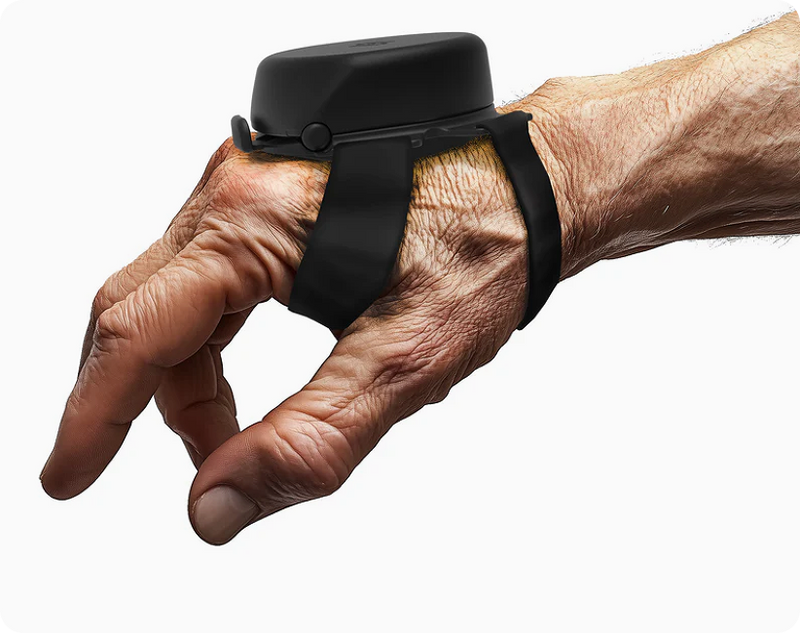
Daily tremor management typically combines four approaches. Adaptive tools and equipment, wearable stabilization devices like the Steadi-3 Plus anti-tremor glove, environmental task modifications, and occupational therapy strategies. Using these solutions together allows many people with Essential Tremor or Parkinson's Disease to maintain control during everyday activities.
Eating and drinking with hand tremors
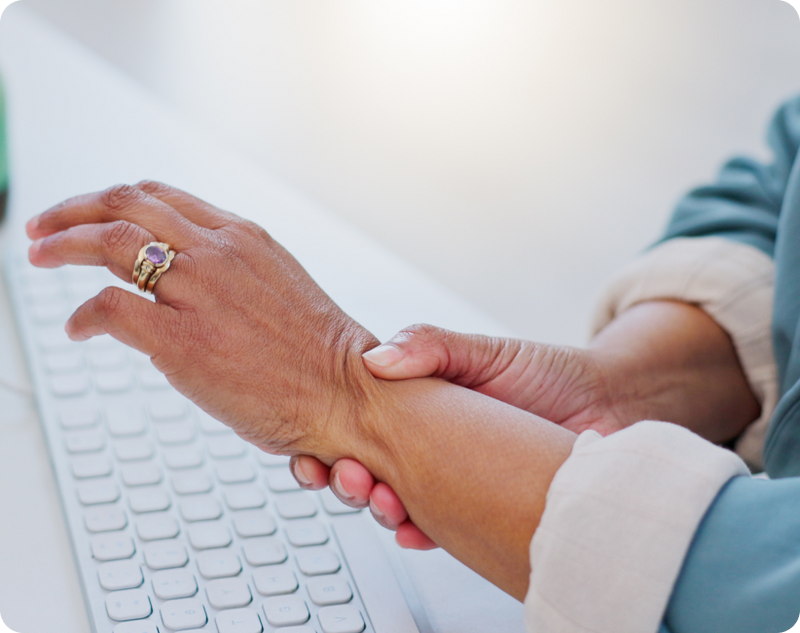
Eating is often affected by action tremors. Solutions include weighted utensils, angled cutlery, non-slip mats, and cups with lids or straws. A wearable stabilization device, such as the Steadi-3 Plus anti-tremor glove, reduces tremor amplitude at the hand itself, helping improve control during meals and drinks.
Writing and fine motor tasks with hand tremors
Writing is another activity where tremors often become more noticeable. Handwriting requires controlled, purposeful movement of the fingers and wrist. When tremor amplitude increases during these movements, pen control becomes difficult. Several adaptive tools and techniques can improve writing accuracy.
Adaptive tools for writing
Thick barrel or weighted pens are commonly recommended by occupational therapists. Increasing the pen diameter reduces the precision required for gripping. Some models include internal weights that dampen small tremor movements.
Foam or rubber pen grips provide a simple and inexpensive alternative. These sleeves slide onto standard pens and pencils to increase grip size and improve control.
Writing guides and line tracers can also help. These devices provide a physical template that guides the pen along a straight path, reducing the impact of small tremor movements.
A clipboard or weighted paper holder keeps the paper stable during writing. When the page remains fixed, the writer can concentrate entirely on pen control rather than repositioning the sheet.
Wearable stabilization during writing
The Steadi-3 Plus anti-tremor glove can also be worn during handwriting tasks. By reducing tremor amplitude at the hand itself, the glove improves stability while allowing the fingers to move freely. Passive fluid damping targets tremor frequency without restricting intentional motion, which is essential for tasks that require controlled finger movement.
Many users find that wearing the glove allows them to continue using familiar writing tools rather than switching to heavily weighted pens.
Digital and technology alternatives
For individuals with moderate to severe tremors affecting handwriting, technology can reduce reliance on manual writing.
Voice recognition software such as Dragon, Google Voice typing, or built in mobile dictation tools allows text to be created without using a pen. This approach is widely used in professional settings.
Touchscreen tablets with stylus support often require less precision than traditional handwriting because the interface provides larger targets.
For many tremor patterns, typing on a keyboard is also easier than handwriting because both hands share the movement and the keys provide tactile feedback.
Task level strategies
Bracing the wrist lightly against the page surface can stabilise the hand during writing. Working in shorter sessions helps reduce fatigue related tremor amplification. Using larger ruled paper also lowers the precision requirement for handwriting.
Managing hand tremors at work
Essential Tremor and Parkinson's Disease tremors do not automatically prevent employment. Many individuals continue working successfully by combining adaptive tools, workplace adjustments, and practical task strategies.
Workplace tool adaptations
In computer-based roles, an ergonomic mouse with wrist support can reduce the impact of tremor on cursor movement. Some users prefer trackballs or vertical mice that allow the wrist to remain in a more neutral position.
Keyboard shortcuts reduce reliance on fine mouse movements, particularly when navigating software interfaces.
Voice recognition software can also streamline tasks such as writing emails or creating documents without extensive keyboard input.
For jobs that require standing, an anti-fatigue mat and adjustable workstation height can help. Prolonged standing often increases postural tremor, while seated workstations tend to provide greater stability.
Organizing the desk environment with document holders and desk organizers reduces the number of small precision placement tasks required throughout the day.
Wearable support during the workday
A wearable stabilization device can provide continuous tremor management throughout the workday. The Steadi-3 Plus anti-tremor glove can be worn during computer use, meetings, and other professional activities.
Because the device contains no electronics and resembles a lightweight glove, it can be worn discreetly in most professional environments. Stabilizing the hand directly can be particularly useful in roles that involve visible hand movements, such as presentations, customer interaction, or note-taking.
Workplace accommodations
Employees in the United States may be entitled to reasonable workplace accommodations under the Americans with Disabilities Act for neurological conditions, including Essential Tremor. Consulting human resources or occupational health departments can help identify available adjustments.
Occupational health assessments can evaluate the workstation and recommend ergonomic changes that support long-term productivity.
Task-level strategies
Scheduling detailed work earlier in the day can help, as fatigue often increases tremor amplitude. Allowing additional time for precision tasks and using digital note-taking instead of handwriting during meetings can also reduce daily stress.
Dressing and personal care with hand tremors
Fine motor tasks involved in dressing and grooming can become challenging when tremors affect grip precision. Occupational therapy practice has produced a wide range of adaptive tools that simplify these activities.
Adaptive dressing tools
A button hook is one of the most widely used dressing aids. The tool includes a small wire loop that slides through the buttonhole and pulls the button through with minimal finger control.
Many clothing manufacturers now offer Velcro fasteners that replace traditional button closures. These systems look similar to standard clothing but fasten with a light press rather than precise pinching.
Elastic shoelaces transform lace-up shoes into slip-on footwear while preserving the appearance of standard laces.
Small accessories such as zip pulls or ring extensions enlarge the grip surface of zipper tabs, making them easier to grasp.
Another option is magnetic button replacements. These closures resemble traditional buttons but fasten using magnets that connect when the fabric edges are pressed together.
Grooming adaptations
Personal care tools are also available for daily hygiene tasks.
An electric razor eliminates the precise blade control required by manual shaving.
A suction base nail brush allows one-handed cleaning without holding the brush.
Many people benefit from a wide-handle toothbrush or an electric toothbrush, which reduces grip demand and improves stability during brushing.
Occupational therapy support
An occupational therapist can evaluate dressing challenges and recommend equipment tailored to the individual's tremor pattern. Many occupational therapy services maintain loan libraries that allow patients to test adaptive tools before purchasing them.
Daily activity solutions — quick reference
The table below summarises the main adaptive solutions for each daily activity. Use it as a starting point. An occupational therapist can help identify which tools best match your tremor pattern and daily routine.
| Daily activity | Main challenge | Adaptive solutions | Steadi-3 Plus advantage |
|---|---|---|---|
| Eating | Spills and utensil control | Weighted utensils, non-slip mats, and lids on cups | Stabilises the hand during meals without changing utensils |
| Writing | Pen control and precision | Thick barrel pens, pen grips, and voice recognition | Reduces tremor amplitude during purposeful writing movement |
| Working | Mouse, keyboard, meetings | Ergonomic mouse, keyboard shortcuts, voice software | Unobtrusive wear during the workday |
| Dressing | Buttons, laces, zips | Button hooks, velcro fasteners, elastic laces | Can be worn during tasks requiring fine hand control |
| Social situations | Cups, hand visibility | Two-hand cup hold, wide cups, seated meals | Helps stabilise visible hand movements |
Individual suitability varies. Always consult a neurologist or occupational therapist before adopting new tremor management strategies.
Hand tremor exercises — can exercise help?
Exercise does not cure or eliminate tremors. However, specific forms of movement training can support muscle strength, coordination, and overall function for people living with Essential Tremor or Parkinson's Disease. When combined with other hand tremor solutions, exercise can improve the performance of daily tasks.
Weight-bearing and resistance exercises
Exercises that involve working against resistance help strengthen muscles around the wrist, elbow, and shoulder. Light resistance bands or small hand weights are commonly used under the supervision of a physiotherapist.
The goal is not to suppress tremors directly. Instead, resistance training improves muscle stability around joints that control hand movement.
Fine motor exercises guided by occupational therapy
Occupational therapists often prescribe fine motor coordination exercises to practise controlled hand movements in a low-pressure environment. Examples include picking up small objects, threading items onto a string, or controlled pouring tasks.
These exercises improve familiarity with hand movements and help individuals practise techniques that stabilise the arm during functional tasks.
Professional guidance is important
Exercise programmes should be designed with the help of a physiotherapist or occupational therapist. Improper exercise techniques can reinforce compensatory movements that make daily tasks harder rather than easier.
Wrist weights for Essential Tremor
Some individuals experiment with wrist weights for Essential Tremor during exercise or daily tasks. The additional resistance may temporarily dampen tremor amplitude. However, wrist weights apply broad resistance to the entire arm and may not target tremor frequency precisely.
Wearable stabilization devices, such as the Steadi-3 Plus anti-tremor glove, are designed to reduce tremor amplitude during functional tasks. Exercise can support general coordination, while devices or medical treatments address tremor reduction itself.
Readers interested in techniques for short-term stabilization can also explore immediate tremor relief techniques at .
Technology and Smartphone Adaptations for Hand Tremors
For most people, navigating hand tremors in daily life means interacting with a phone dozens of times a day, typing on a laptop, and relying on connected devices at home. The good news is that the technology ecosystem has quietly built a rich layer of accessibility features, adaptive software, and voice-driven tools designed to make all of this dramatically easier. The challenge is that most of these options are underused, often because patients and caregivers don't know they exist. This section walks through the most useful adaptations across phones, computers, and smart home devices — the kinds of tweaks that can meaningfully improve living with Essential Tremor without requiring any new prescription or procedure.
Using a smartphone with hand tremors: Built-In Accessibility Features
Modern smartphones include a surprising range of settings that are particularly helpful for people with shaky hands. If you've been frustrated by mis-taps, accidental swipes, or the difficulty of using a smartphone with hand tremors, the first step is opening your accessibility settings:
- AssistiveTouch (iOS) creates a floating on-screen menu that reduces the need to press physical buttons, making the home button, volume, and gestures available with a single, easier tap.
- Touch Accommodations (iOS) let you adjust how long the screen must be touched before a tap is registered, which filters out the quick, accidental contact that tremor motion often produces.
- Android's Touch and Hold Delay and broader Motor Accessibility options offer similar calibration options, letting you tune tap sensitivity and hold duration to your specific tremor pattern.
- Voice control through Siri, Google Assistant, or Alexa allows fully hands-free navigation of the phone — making calls, sending texts, opening apps, and searching the web without any screen interaction.
- Larger text and high-contrast display settings make fine-targeting of small interface elements easier, particularly for reading and tapping links.
- Voice-to-text dictation removes the need to type on a small touchscreen keyboard entirely. It works in texts, emails, notes, and most third-party apps, and modern dictation accuracy is high enough to reliably draft long messages.
Essential Tremor Technology Adaptations for Computers
Computer work is often where tremors cause the most daily frustration, because cursor precision and keyboard accuracy are both affected. Thankfully, the software and hardware layer here is particularly well-developed:
- SteadyMouse (available from SteadyMouse.com) is adaptive mouse software designed for users with hand tremors. It smooths cursor movement and filters out the erratic motion introduced by tremors, making clicking on small targets dramatically more reliable.
- Ergonomic mice, particularly trackball and vertical mice, reduce the wrist movement required for cursor control. A trackball keeps the wrist stationary while the thumb moves the ball, which is often much more manageable than moving the whole hand across a pad.
- Keyboard shortcuts and hotkeys eliminate many precision pointing tasks altogether, letting you navigate most applications without continuous cursor control.
- Eye-tracking software is an emerging option for people with moderate-to-severe tremors. The cursor follows your gaze rather than your hand, effectively bypassing the tremor entirely.
- Dictation software such as Dragon NaturallySpeaking enables hands-free document creation, email, and web browsing. For many users, using a computer with Essential Tremor becomes far less tiring once dictation replaces typing for longer content.
Smart Home Technology
Beyond phones and computers, voice-activated devices have quietly reshaped everyday tasks at home:
- Voice-activated speakers (Amazon Echo, Google Home, Apple HomePod) enable hands-free control of lighting, music, timers, phone calls, and shopping lists — reducing the number of fine-motor tasks required throughout a typical day.
- Smart locks with keypad codes or phone-based unlocking eliminate the grip-and-turn challenge of standard door keys, which is often one of the first daily frustrations patients mention.
- A tablet on a stand for video calls is substantially more stable than holding a phone during a conversation. This simple change improves both communication clarity and social connection — a quiet but meaningful benefit that other Essential Tremor technology adaptations can't replicate.
Taken together, these tools don't replace medical treatment, but they remove friction from the dozens of small technology interactions that otherwise make each day harder.
How occupational therapy supports daily tremor management
Occupational therapy is the medical specialty most closely focused on helping people maintain independence in daily activities. After consultation with a neurologist, an occupational therapist is often the professional best equipped to address practical tremor management.
During an occupational therapy assessment, the therapist evaluates which daily tasks are most affected by tremors. This may include eating, writing, dressing, computer use, or workplace activities.
The therapist can recommend adaptive tools and allow patients to trial equipment before purchasing it. They may also suggest environmental modifications at home or at work and teach compensatory techniques to reduce the impact of tremor during specific tasks.
Occupational therapy is not limited to cases of severe tremor. Even mild-to-moderate Essential Tremor affecting professional or daily activities can benefit from structured assessment and strategy development.
Access to occupational therapy usually occurs through referral from a neurologist, general practitioner, or movement disorder specialist. Some clinics also accept self-referral depending on local healthcare policies.
Occupational therapists may also evaluate whether devices such as the Steadi-3 Plus anti-tremor glove are appropriate for a patient's tremor pattern and daily activities. The device is designed to complement occupational therapy strategies rather than replace them.
Navigating social situations with hand tremors
Social situations can present practical challenges when tremors affect visible hand movements. Simple preparation strategies can make these situations easier to manage.
When eating in restaurants, selecting dishes that are easier to handle can reduce stress during meals. Foods that require minimal liquid handling are often easier to manage than soups or loose grains. Requesting cups with lids or straws can also reduce the risk of spills.
For social drinking, using a straw or holding the cup with both hands provides additional stability. Cups with handles are often easier to control than smooth glasses.
Professional greetings, such as handshakes, can still be approached normally. A firm two-handed handshake is widely accepted in many social settings. Wearing the Steadi-3 Plus anti-tremor glove can also help stabilise visible hand movement during interactions.
Some individuals choose to explain their tremor briefly to close colleagues or friends. A simple, matter-of-fact explanation often reduces uncertainty and helps others understand the condition.
Essential Tremor does not have to limit participation in social environments. Combining adaptive tools, practical strategies, and wearable stabilization devices allows people to manage tremors proactively in many situations.
Frequently Asked Questions
Common assistive devices for hand tremors include weighted utensils, thick-barrel pens, pen grips, button hooks, elastic shoelaces, and spill-resistant cup lids. These tools help by increasing grip surface area, adding stabilizing weight, or simplifying fine motor movements. Weighted utensils can make eating steadier, while thick pens and grips reduce the precision needed for writing. Button hooks and elastic laces make dressing easier by minimizing small finger movements. Non-slip mats can also stabilize plates and bowls during meals. An occupational therapist can assess your tremor pattern, daily routines, and environment to recommend the most effective adaptive tools and strategies for maintaining independence.
Yes, many people with Essential Tremor continue working successfully and maintain productive careers across a wide range of professions. The condition varies in severity, and many individuals find that workplace adjustments can significantly improve comfort and performance. Helpful strategies include using ergonomic keyboards and mice, voice-recognition software for typing, keyboard shortcuts, and document-dictation tools. Adjustable desks, wrist supports, and workstation modifications can also improve stability and reduce strain. Some employees benefit from flexible scheduling or task adjustments when tremor symptoms fluctuate. In addition, wearable stabilization devices, such as the Steadi-3 Plus anti-tremor glove, may help improve hand control during activities like writing, typing, or tool use.
Yes, occupational therapy can play an important role in helping people manage hand tremors and maintain independence in everyday life. Occupational therapists focus on improving a person’s ability to perform daily tasks such as eating, writing, dressing, grooming, and using technology. During therapy, the therapist evaluates tremor patterns, hand strength, coordination, and how tremors affect specific activities. Based on this assessment, they may recommend adaptive tools like weighted utensils, writing aids, or assistive dressing devices. They also teach practical techniques such as stabilizing the arm, modifying movement patterns, or organizing workspaces. Referral to occupational therapy is often provided through a neurologist, movement-disorder specialist, or general practitioner.
Several strategies and assistive tools can make eating easier and safer for people with hand tremors. Weighted utensils are commonly recommended because the added weight can help stabilize hand movements and reduce shaking during meals. Non-slip mats placed under plates and bowls prevent dishes from sliding, while cup lids or spill-resistant mugs reduce the risk of spills when drinking. Many people find that stabilizing the elbow on the table provides additional control, and using two hands to hold cups or bowls can improve steadiness. Eating slowly and remaining seated in a supportive position also helps. Some individuals choose wearable stabilization devices, such as the Steadi-3 Plus anti-tremor glove, for added hand control.
The Steadi-3 Plus anti-tremor glove is designed to help people perform everyday activities that are commonly affected by hand tremors. Tasks such as eating, writing, using tools, or performing desk work can become more manageable when additional hand stability is available. The glove uses a passive fluid-damping mechanism that reduces tremor amplitude while still allowing intentional hand movements. Because it does not rely on batteries or electronics, it can be worn throughout the day without charging. Clinical evaluation has reported improvements in tremor amplitude during functional tasks, helping users maintain steadier hand motion. The glove can be worn whenever additional stability is needed during daily routines or professional activities.
Yes — and connecting with others who understand the condition is one of the most underrated parts of coping with Essential Tremor. The International Essential Tremor Foundation (IETF) maintains an active online Essential Tremor support group on Facebook, along with a directory of in-person groups across the United States. The Tremor Talk blog at EssentialTremor.org adds a broader peer-community layer through articles, stories, and forums. Many neurological hospitals and movement disorder centers also run their own local support groups, and a neurologist or occupational therapist is often the fastest way to get a referral. Beyond practical tips for daily tasks, support groups reduce the sense of isolation that can come with living with Essential Tremor and are documented as beneficial for emotional well-being in people managing chronic movement disorders. If you or a loved one is newly diagnosed, this is one of the easiest and most valuable steps to take early.